




Last updated: August 22, 2026 — verified against OpenAI’s current GPT-5.6 product, pricing and ChatGPT availability documentation.
OpenAI’s GPT-5.6 family has three main API models: Sol, Terra and Luna. Sol is the highest-capability tier, Terra balances capability and cost for everyday work, and Luna is the fastest, lowest-cost member of the family. The important detail is that API availability and standard ChatGPT availability are not identical, so this guide separates the two.
GPT-5.6 Sol, Terra and Luna

GPT-5.6 Sol is OpenAI’s flagship reasoning model for complex coding, knowledge work, research, cybersecurity, science, computer use and design. In ChatGPT, Sol powers the higher reasoning options on eligible paid plans, while Sol Pro is the highest-capability GPT-5.6 option for difficult and longer-running workflows.
GPT-5.6 Terra is the balanced model for everyday work where capability, latency and cost all matter. OpenAI continues to offer Terra in ChatGPT Work, Codex and the OpenAI API rather than as a normal selectable model in standard ChatGPT conversations.
GPT-5.6 Luna is the fastest and lowest-cost GPT-5.6 model. OpenAI’s current ChatGPT documentation says Luna is becoming the default model for Free and Go users, while paid users can access Sol reasoning options. Luna is also available through Work, Codex and the OpenAI API.
GPT-5.6 API Pricing After the July 30 Cut
| Model | Input / 1M tokens | Output / 1M tokens |
|---|---|---|
| GPT-5.6 Sol | $5.00 | $30.00 |
| GPT-5.6 Terra | $2.00 | $12.00 |
| GPT-5.6 Luna | $0.20 | $1.20 |
On July 30, 2026, OpenAI cut Terra’s API price by 20% and Luna’s by 80%. Sol pricing did not change. Processing modes, long-context rates, caching and provider-specific pricing can differ from the base rates above, so API buyers should confirm the live OpenAI pricing page when budgeting.
Which GPT-5.6 Model Should You Use?
- Sol: use for difficult reasoning, long-running coding and high-value tasks where quality matters more than base token cost.
- Terra: use for everyday professional workloads, scoped coding, analysis and agent steps where a balanced cost-performance profile matters.
- Luna: use for high-volume, well-defined tasks, classification, routine automation and latency-sensitive workloads.
The most cost-effective architecture can mix tiers. A workflow can use Sol to resolve ambiguity or plan a difficult task, then hand clearer implementation steps to Terra or Luna.
GPT-5.6 in ChatGPT
In standard ChatGPT conversations, model labels do not map one-to-one to every API model. OpenAI’s current Help Center says eligible paid plans can use GPT-5.6 Sol through reasoning levels such as Medium and High, with higher options on some plans. Free and Go users do not get Sol; GPT-5.6 Luna is becoming their default model. Terra and Luna are not generally selectable as normal models in standard paid ChatGPT conversations, but are available in Work, Codex and the API depending on plan.
GPT-5.6 vs Claude and Gemini
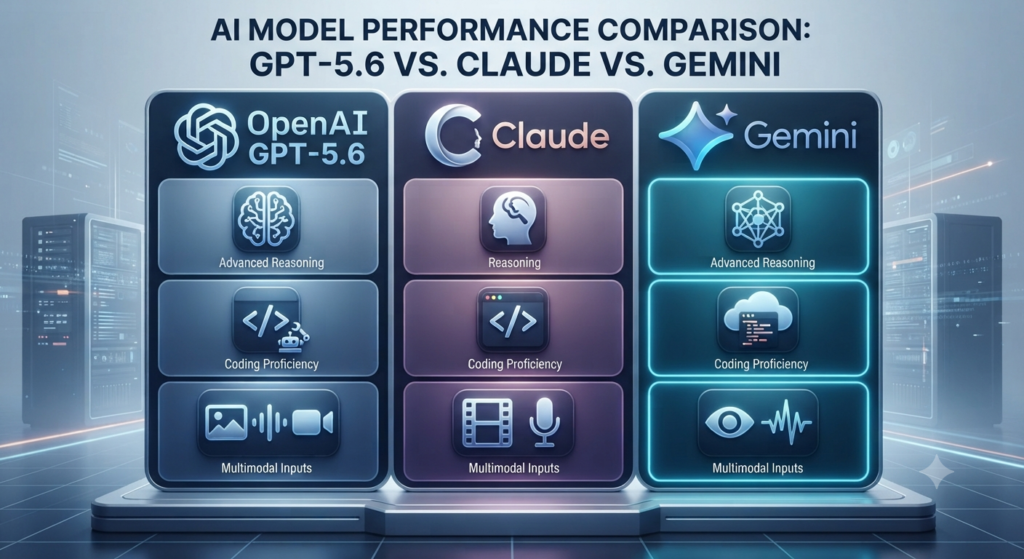
OpenAI, Anthropic and Google all now offer several cost-performance tiers. Current comparisons should use exact models rather than brand-level claims: for example, Sol against current high-end Claude models, Terra against balanced production options, and Luna against lower-cost high-throughput alternatives. Results vary by task, so benchmark your own workload before standardizing on a vendor.
FAQ
What is the cheapest GPT-5.6 API model? Luna. OpenAI reduced its base API price to $0.20 per million input tokens and $1.20 per million output tokens on July 30, 2026.
Can Free and Go users use GPT-5.6 Sol? No. OpenAI’s current ChatGPT documentation says Free and Go users do not have Sol access; Luna is becoming their default GPT-5.6 model.
Can I select Terra in a normal ChatGPT conversation? OpenAI says Terra and Luna are not selectable in standard ChatGPT conversations. They remain available in products such as Work, Codex and the OpenAI API depending on plan.