


Last updated: September 25, 2026 — based on Google’s current Gemini API release notes and model guidance.
If you are choosing a Gemini model for a new application, the useful comparison is no longer a generic “Pro vs Flash” debate. The practical 2026 decision is usually between Gemini 3.8 Flash for difficult agentic and coding work, Gemini 3.5 Flash-Lite for high-volume cost-sensitive execution, and any older or Pro-tier model only when your existing workload gives it a measurable advantage.
Quick Decision Table
| Workload | Start With | Why |
|---|---|---|
| Long-horizon coding | Gemini 3.8 Flash | Google positions it for software engineering and complex multi-step execution. |
| Autonomous agents | Gemini 3.8 Flash | Designed for agentic and enterprise workflows. |
| High-volume extraction / classification | Gemini 3.5 Flash-Lite | Optimized for low latency and cost efficiency. |
| Routine agent substeps | Gemini 3.5 Flash-Lite | Useful when the planner is stronger than the executor. |
| Existing older Gemini deployment | Benchmark before migrating | Prompt behavior, latency and economics may differ. |
Gemini 3.8 Flash vs Gemini 3.5 Flash-Lite
The core trade-off is capability versus throughput. Gemini 3.8 Flash is the stronger starting point when a task involves long-horizon reasoning, coding, tool use or autonomous execution. Gemini 3.5 Flash-Lite is the better first benchmark when requests are repetitive, well-scoped and numerous.
That does not mean one model should run an entire agent system. A cost-efficient architecture can use 3.8 Flash to plan, resolve ambiguity or recover from failures, while Flash-Lite handles clear repetitive steps. The meaningful metric is cost per successfully completed task, not token price in isolation.
What About Pro Models?
Google’s catalog has included Pro-tier models for advanced reasoning, but new deployments should not assume “Pro” automatically wins. Google’s 2026 Flash line has moved strongly into coding and agentic work, and its own migration guidance increasingly directs developers toward newer Flash releases. If a Pro model is available for your workload, benchmark it against 3.8 Flash with the same prompts, tools and acceptance criteria.
How to Benchmark Gemini Models Properly
- Task success: did the model actually complete the job?
- Human correction: how much review or repair was required?
- Latency: measure end-to-end completion time, not just first-token speed.
- Tool reliability: track failed calls, retries and invalid arguments.
- Token use: include retries and long-context overhead.
- Total cost: calculate cost per successful outcome.
Migration Notes for 2026
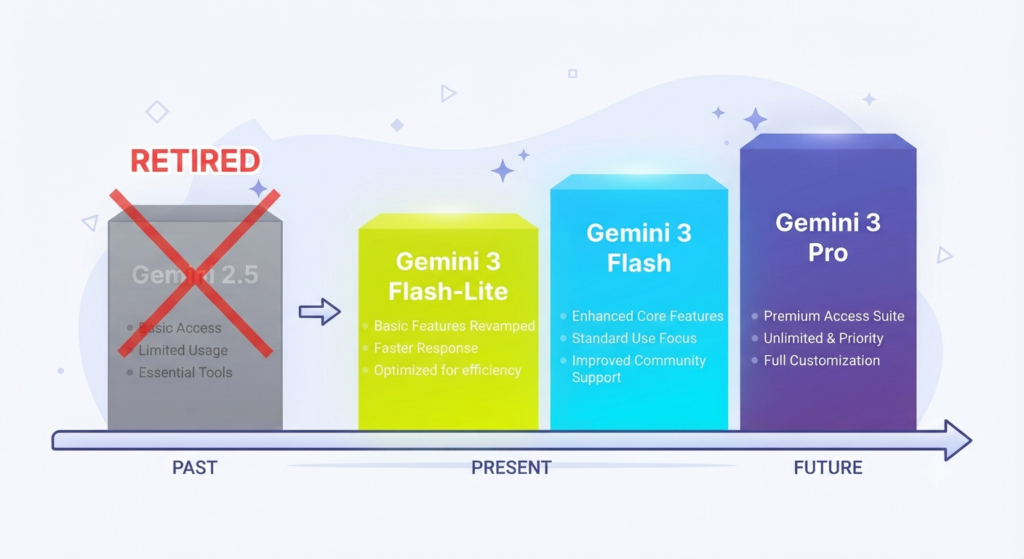
Google’s September release notes say Gemini 2.5 access is being limited to users who actively used those models previously, while new projects should use newer options such as Gemini 3.8 Flash or 3.5 Flash-Lite. That is a strong signal to treat older model comparisons as migration references rather than default recommendations.
The Vynula Recommendation Method
Vynula does not assign a universal winner because model quality depends on workload. We separate capability, latency, cost, tool reliability and migration risk. A model is “better” only when it improves the outcome you actually care about.
FAQ
Which Gemini model should most new projects test first? For demanding general-purpose work, Gemini 3.8 Flash. For high-volume cost-sensitive work, Gemini 3.5 Flash-Lite.
Is Gemini 2.5 discontinued? No. Google says it is not deprecated, but access is limited for new projects and newer models are recommended.
Should I always choose Pro over Flash? No. Benchmark the exact current models on your own workload; the recent Flash line is explicitly designed for coding and agentic work.