




Last updated: August 22, 2026 — verified against current OpenAI product and Help Center documentation.
ChatGPT is no longer best understood as a single model. In 2026, OpenAI separates the product into different experiences and model tiers: everyday Chat, longer-running Work, software-focused Codex, and the GPT-5.6 model family led by Sol, Terra and Luna. Which model you actually see depends on your plan and the part of ChatGPT you are using.
The Current GPT-5.6 Family
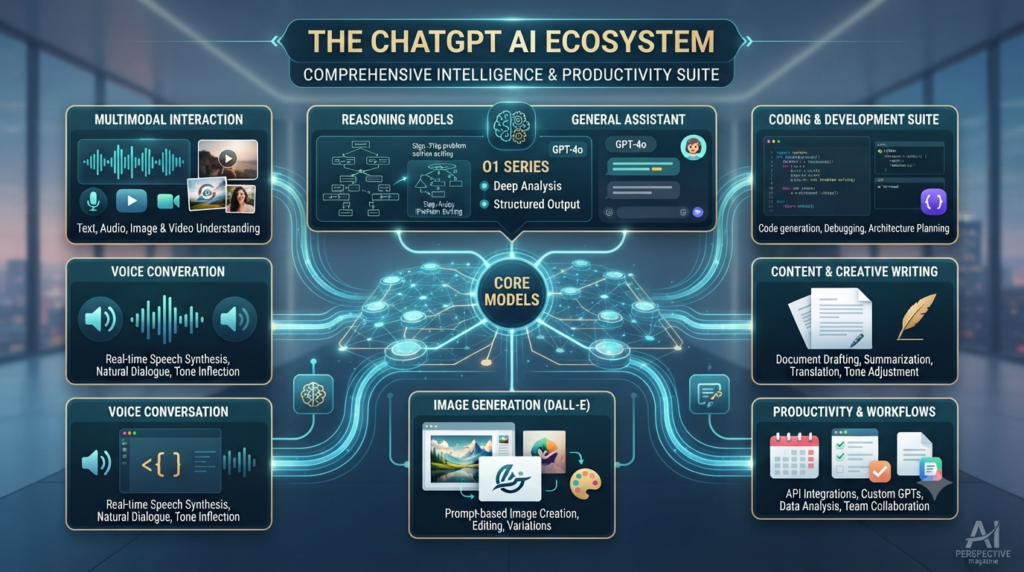
- GPT-5.6 Sol: flagship reasoning model for complex coding, research, science, cybersecurity, computer use and design.
- GPT-5.6 Sol Pro: highest-capability GPT-5.6 option for difficult and longer-running workflows where available.
- GPT-5.6 Terra: balanced model for everyday professional work in Work, Codex and the API.
- GPT-5.6 Luna: fastest, lowest-cost member of GPT-5.6; OpenAI says it is becoming the default for Free and Go ChatGPT users.
- GPT-5.5 Instant: still used for fast everyday responses in some ChatGPT experiences during the current rollout.
Chat, Work and Codex Are Different Experiences
Chat is for conversational assistance, search, brainstorming and everyday questions. Work is an agent for longer multi-step projects and finished deliverables such as documents, spreadsheets, presentations, reports and Sites. Codex remains focused on software development and technical work.
This distinction matters because Terra and Luna can be available in Work or Codex even when they are not selectable as ordinary models in a standard ChatGPT conversation.
What Happened to Canvas?
Canvas is being phased out of newer ChatGPT model experiences. OpenAI moved writing and coding editing directly into chat through writing blocks and code blocks. Paid users may still encounter legacy Canvas access through older models during the transition, but new content should not present Canvas as the primary current editing workflow.
Projects, Memory, Voice and Research
Projects remain available as workspaces that group chats, files and instructions around a longer-running effort. ChatGPT also supports memory and voice in supported experiences, while research and agentic capabilities vary by plan and product surface. Feature availability can change independently of the underlying model, so model choice and product feature choice should be treated separately.
Which ChatGPT Model Should You Choose?
For a detailed model-by-model decision guide, see our Sol vs Terra vs Luna comparison. In general, use Sol when difficult reasoning justifies more compute, Terra for balanced professional work where available, and Luna for high-volume or cost-sensitive tasks.