



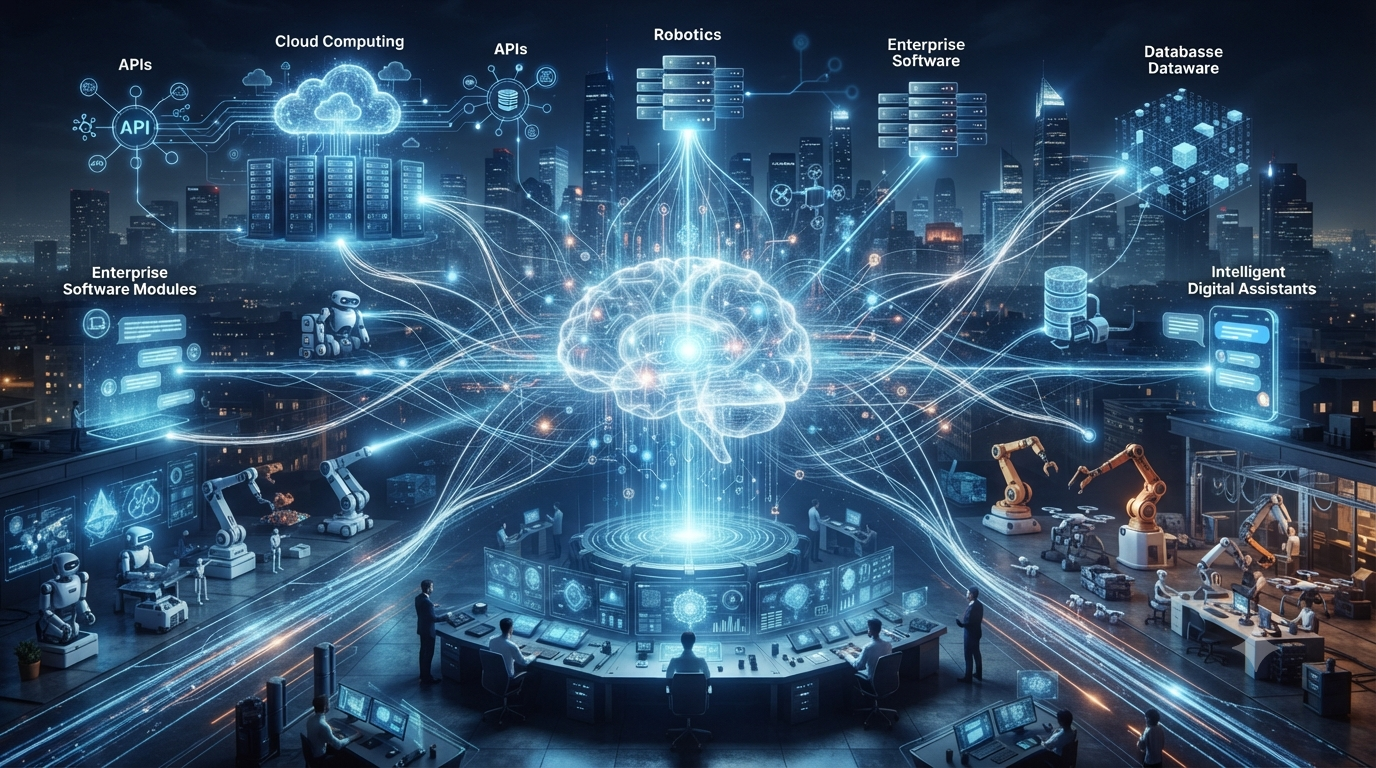
Quick Answer
Agentic AI refers to artificial intelligence systems that can plan, reason, make decisions, use external tools, and complete complex tasks with minimal human intervention.
Unlike traditional AI chatbots that simply answer questions, Agentic AI can pursue goals, break large problems into smaller steps, interact with software, retrieve information, execute actions, and continuously adapt based on results.
Think of Agentic AI as the difference between asking someone for directions and hiring a skilled assistant who plans the entire trip, books your hotel, monitors traffic, and adjusts the itinerary if something changes.
In 2026, Agentic AI has become one of the fastest-growing areas of artificial intelligence, powering autonomous coding assistants, enterprise automation, research platforms, customer service systems, and next-generation digital employees.
Key Takeaways
- Agentic AI focuses on achieving goals rather than simply generating responses.
- AI agents can plan, reason, remember, and use external tools.
- Modern AI agents often combine large language models with technologies like MCP, APIs, memory systems, and workflow engines.
- Agentic AI is transforming software development, business automation, research, and customer support.
- Companies are increasingly investing in AI agents capable of completing multi-step workflows with minimal supervision.
- Understanding Agentic AI is essential for anyone following the future of artificial intelligence.
Table of Contents
- What Is Agentic AI?
- Why Is Everyone Talking About Agentic AI?
- How Agentic AI Works
- AI Agents vs Traditional Chatbots
- Core Components of an AI Agent
- Real-World Examples
- Types of AI Agents
- Agentic AI vs Generative AI
- Enterprise Applications
- Benefits and Limitations
- Security Challenges
- Future of Agentic AI
- Frequently Asked Questions
- Final Verdict
What Is Agentic AI?
Agentic AI describes artificial intelligence systems that are designed to act with a degree of autonomy in order to achieve specific objectives.
Rather than waiting for a single prompt and generating one response, an AI agent can evaluate a goal, decide what information it needs, choose appropriate tools, execute actions, assess the outcome, and continue working until the objective is complete.
For example, instead of simply answering:
“How do I launch a product?”
an Agentic AI system could:
- Research competitors
- Analyze market trends
- Generate a marketing plan
- Create a project timeline
- Assign tasks
- Draft promotional content
- Monitor progress
- Suggest improvements
All while asking for human approval only when necessary.
This ability to combine reasoning, planning, memory, and tool use is what makes Agentic AI fundamentally different from traditional conversational AI.
Why Is Everyone Talking About Agentic AI?
For years, AI was primarily viewed as a tool for answering questions or generating text.
Large language models demonstrated impressive reasoning abilities, but they still relied heavily on human guidance.
The emergence of Agentic AI changes that relationship.
Instead of acting like a search engine or writing assistant, AI begins functioning more like a collaborative teammate capable of completing real work.
Several trends have accelerated interest in Agentic AI:
Better Language Models
Modern AI models are significantly better at reasoning, planning, and following complex instructions than earlier generations.
Tool Integration
Standards such as Model Context Protocol (MCP) enable AI systems to interact with databases, APIs, cloud platforms, and business software through standardized interfaces.
Longer Context Windows
AI models can now maintain awareness across much larger conversations and documents, making long-running tasks more practical.
Improved Memory
Persistent memory allows AI agents to remember previous interactions, user preferences, and project details.
Enterprise Demand
Organizations increasingly want AI systems that can automate workflows rather than simply answer questions.
How Agentic AI Works

Although implementations vary, most AI agents follow a similar operational cycle.
Step 1 – Receive a Goal
The user provides an objective rather than a single question.
Example:
“Prepare a weekly sales report.”
Step 2 – Plan
Instead of immediately responding, the agent creates a plan.
It may decide to:
- Retrieve sales data
- Analyze trends
- Compare previous weeks
- Create visualizations
- Write an executive summary
Step 3 – Select Tools
The agent determines which external tools are required.
Examples include:
- Databases
- Cloud storage
- CRM platforms
- Email systems
- GitHub
- Google Workspace
- Analytics dashboards
Step 4 – Execute
The agent interacts with these systems, often through protocols such as MCP or other secure integrations.
Step 5 – Evaluate
The AI reviews the results.
If information is missing or incomplete, it can revise its approach and continue working.
Step 6 – Deliver
The final output may include:
- Reports
- Emails
- Code
- Presentations
- Dashboards
- Recommendations
Instead of one answer, the user receives a completed workflow.
AI Agents vs Traditional Chatbots

Many people mistakenly assume every chatbot is an AI agent.
In reality, there are important differences.
| Feature | Traditional Chatbot | Agentic AI |
|---|---|---|
| Answers Questions | ✅ | ✅ |
| Plans Tasks | ❌ | ✅ |
| Uses External Tools | Limited | ✅ |
| Multi-Step Reasoning | Limited | ✅ |
| Memory | Limited | Often Persistent |
| Goal-Oriented | ❌ | ✅ |
| Executes Actions | Rarely | Frequently |
A chatbot typically reacts to prompts.
An AI agent proactively works toward completing objectives.
Core Components of an AI Agent
Most modern Agentic AI systems combine several technologies.
Reasoning Engine
The reasoning engine helps the agent analyze situations, evaluate options, and decide what to do next.
Rather than producing a single response, it continually reassesses progress until the goal is achieved.
Planning System
Planning allows the AI to divide complex objectives into manageable tasks.
Large projects become structured workflows instead of isolated prompts.
Memory
Memory enables the agent to retain relevant information between interactions.
Examples include:
- User preferences
- Previous conversations
- Ongoing projects
- Company policies
- Frequently used tools
Persistent memory allows AI assistants to become increasingly helpful over time.
Tool Use
One of the defining features of Agentic AI is the ability to use external tools.
These may include:
- Web browsers
- Databases
- APIs
- File systems
- Development environments
- Business software
- Cloud platforms
Instead of relying solely on training data, agents interact with live systems to complete real tasks.
Decision Making
Agentic AI evaluates outcomes continuously.
If an approach fails, it may choose an alternative strategy instead of simply returning an error.
This adaptive behavior is one of the reasons Agentic AI is attracting significant enterprise interest.
Real-World Examples of Agentic AI
Agentic AI is already appearing across many industries.
Software Development
An AI coding agent can analyze a bug report, inspect the codebase, suggest a fix, generate code, run tests, and prepare a pull request.
Customer Support
An AI support agent retrieves customer history, checks product documentation, processes refunds where authorized, and drafts personalized responses.
Research
Research agents gather information from multiple sources, compare findings, summarize evidence, and generate comprehensive reports.
Marketing
Marketing agents analyze audience data, create campaigns, schedule content, monitor performance, and recommend optimizations.
Business Operations
Enterprise AI assistants coordinate meetings, prepare reports, monitor key performance indicators, update documentation, and automate repetitive workflows.
Why Agentic AI Matters
The shift from conversational AI to Agentic AI represents one of the most important developments in artificial intelligence.
Instead of acting merely as intelligent chat interfaces, AI systems are becoming capable collaborators that can plan, execute, and improve complex workflows.
For businesses, this means greater productivity.
For developers, it means building smarter applications.
For individuals, it means having AI assistants that can do far more than answer questions—they can help accomplish meaningful work.
Types of AI Agents
Not all AI agents operate in the same way.
Depending on their capabilities and level of autonomy, AI agents can be categorized into several types.
Understanding these categories helps explain why some AI systems simply answer questions while others can complete complex business workflows.
Reactive Agents
Reactive agents respond only to the current situation.
They do not retain long-term memory or plan future actions.
Examples include:
- Basic customer service bots
- FAQ assistants
- Simple recommendation engines
These systems are useful for repetitive tasks but cannot manage complex projects.
Goal-Based Agents
Goal-based agents work toward completing a specific objective.
Instead of producing a single response, they evaluate different options before choosing the best course of action.
For example:
A user asks:
“Plan my business trip to Tokyo.”
A goal-based AI agent may:
- Search flights
- Compare hotel prices
- Build an itinerary
- Suggest restaurants
- Estimate travel costs
The focus is achieving the goal rather than answering one question.
Learning Agents
Learning agents improve over time by incorporating feedback and new information.
They can:
- Adapt to user preferences
- Improve recommendations
- Optimize workflows
- Learn organizational policies
- Personalize future interactions
Persistent memory makes these agents increasingly valuable in long-term use.
Multi-Agent Systems
Rather than relying on one powerful AI, some organizations deploy several specialized agents working together.
For example:
A software company may use:
- Planning Agent
- Coding Agent
- Testing Agent
- Documentation Agent
- Deployment Agent
Each agent performs a specific task while collaborating with the others.
This modular approach often improves scalability and reliability.
Single-Agent vs Multi-Agent Systems
One of the fastest-growing trends in enterprise AI is the move toward multi-agent collaboration.
Single-Agent Architecture
One AI agent performs every task.
Advantages:
- Simpler implementation
- Lower infrastructure complexity
- Easier deployment
Limitations:
- Bottlenecks
- Limited specialization
- Reduced scalability
Multi-Agent Architecture
Several AI agents cooperate to accomplish larger objectives.
Advantages include:
- Task specialization
- Parallel execution
- Better fault tolerance
- Greater scalability
- Improved efficiency
For example, a product launch could involve:
- Research Agent
- Content Agent
- SEO Agent
- Design Agent
- Publishing Agent
- Analytics Agent
Together, these agents complete work that would otherwise require an entire human team.
Agentic AI vs Generative AI
Although the terms are often used interchangeably, they represent different concepts.
| Feature | Generative AI | Agentic AI |
|---|---|---|
| Generates Text | ✅ | ✅ |
| Creates Images | ✅ | Sometimes |
| Plans Tasks | ❌ | ✅ |
| Uses Tools | Limited | ✅ |
| Makes Decisions | Limited | ✅ |
| Executes Actions | Rarely | Frequently |
| Goal-Oriented | ❌ | ✅ |
| Autonomous | Limited | High |
Generative AI focuses on creating content such as text, images, code, audio, or video.
Agentic AI builds upon generative AI by adding planning, reasoning, memory, decision-making, and tool usage.
In other words:
Every Agentic AI system typically uses generative AI, but not every generative AI system is agentic.
Enterprise Use Cases

Agentic AI is rapidly transforming how organizations operate.
Instead of automating isolated tasks, AI agents can coordinate complete business processes.
Software Development
Development teams increasingly use AI agents to:
- Analyze repositories
- Write code
- Review pull requests
- Execute tests
- Update documentation
- Detect security issues
Rather than replacing developers, these agents act as intelligent collaborators.
Customer Support
Support agents can:
- Retrieve customer records
- Analyze previous conversations
- Search internal documentation
- Process requests
- Draft personalized responses
- Escalate complex cases
This reduces response times while improving customer satisfaction.
Marketing
Marketing teams use AI agents to:
- Research competitors
- Generate campaign ideas
- Create content calendars
- Optimize advertisements
- Analyze campaign performance
- Produce reports
Instead of completing one task, the agent manages an entire workflow.
Healthcare
Healthcare organizations are exploring AI agents for:
- Clinical documentation
- Appointment scheduling
- Medical record retrieval
- Administrative automation
- Research assistance
Human oversight remains essential, especially for clinical decision-making.
Finance
Financial institutions use AI agents to:
- Generate reports
- Detect anomalies
- Analyze transactions
- Monitor compliance
- Prepare forecasts
These systems improve efficiency while supporting regulatory requirements.
Human Resources
HR departments can use AI agents to:
- Screen resumes
- Schedule interviews
- Answer employee questions
- Recommend training
- Generate onboarding materials
Routine administrative work becomes faster and more consistent.
Benefits of Agentic AI

Organizations are investing heavily in Agentic AI because of its potential to improve productivity and decision-making.
Increased Productivity
AI agents automate repetitive work, allowing employees to focus on higher-value tasks.
Faster Decision-Making
Agents gather information from multiple sources and provide actionable recommendations in minutes instead of hours.
Continuous Availability
Unlike human teams, AI agents can operate around the clock without fatigue.
Workflow Automation
Instead of automating individual actions, Agentic AI automates complete business processes.
Better Collaboration
AI agents can coordinate information across multiple departments, tools, and software platforms.
Scalable Operations
Organizations can deploy additional agents as workloads grow without dramatically increasing staffing requirements.
Limitations of Agentic AI
Despite its promise, Agentic AI also presents several challenges.
Hallucinations
AI agents may generate incorrect information if they lack reliable external data or validation mechanisms.
Complex Planning
Long workflows increase the possibility of mistakes or unexpected outcomes.
Tool Reliability
An AI agent depends on the availability and quality of the tools it uses.
If an external API fails, the workflow may also fail.
Cost
Running advanced AI agents often requires:
- Large language models
- Cloud infrastructure
- Databases
- Monitoring systems
- Security controls
This can increase operational costs.
Human Oversight
Most enterprise deployments still require humans to review important decisions, especially in regulated industries.
Security Considerations
Because Agentic AI can perform real-world actions, security is a critical concern.
Organizations should implement:
- Strong authentication
- Role-based access control
- Secure API management
- Encryption
- Audit logging
- Human approval for sensitive actions
- Continuous monitoring
- Least-privilege permissions
Agentic AI should never receive unrestricted access to critical business systems.
Proper governance ensures that AI agents remain helpful without introducing unnecessary risk.
Why Businesses Are Investing in Agentic AI
Businesses increasingly view Agentic AI as the next major step beyond traditional automation.
Instead of writing rules for every possible scenario, organizations can define objectives and allow AI agents to determine how to achieve them.
This shift reduces manual effort, accelerates operations, and enables employees to focus on strategic work.
As language models become more capable and standards like Model Context Protocol (MCP) continue to mature, Agentic AI is expected to play a central role in the future of enterprise software and intelligent automation.
The Future of Agentic AI
Artificial intelligence is entering a new phase.
For years, AI focused on understanding language, generating text, and answering questions. While these capabilities remain valuable, the next generation of AI is expected to spend less time responding and more time accomplishing real-world objectives.
This is the promise of Agentic AI.
Future AI systems are expected to become increasingly capable of:
- Planning long-term projects
- Coordinating multiple AI agents
- Using hundreds of software tools
- Learning user preferences
- Collaborating with human teams
- Managing business workflows
- Monitoring ongoing tasks
- Making context-aware decisions
Rather than replacing existing software, Agentic AI will increasingly act as an intelligent orchestration layer connecting people, applications, and business processes.
As standards such as Model Context Protocol (MCP) continue to mature, AI agents are likely to become more interoperable, making it easier for organizations to deploy secure, scalable automation across different platforms.
The Relationship Between Agentic AI and MCP
One of the biggest reasons Agentic AI has gained momentum is the emergence of standardized integration methods like Model Context Protocol (MCP).
Agentic AI provides the intelligence.
MCP provides the communication layer.
Together they allow AI systems to:
- Access databases
- Use cloud applications
- Execute workflows
- Read documentation
- Control developer tools
- Interact with enterprise software
Without standardized communication, AI agents would require separate custom integrations for every platform.
MCP simplifies this process by providing a consistent interface between AI models and external systems.
This combination is expected to become one of the foundations of enterprise AI over the coming years.
Will Agentic AI Replace Human Workers?
This is one of the most common questions surrounding Agentic AI.
The answer is more nuanced than a simple yes or no.
AI agents are exceptionally good at:
- Repetitive tasks
- Information retrieval
- Data analysis
- Workflow automation
- Administrative work
- Software assistance
However, they still depend on humans for:
- Strategic decision-making
- Creativity
- Ethical judgment
- Leadership
- Relationship building
- Complex negotiations
For most organizations, Agentic AI is more likely to augment human teams than completely replace them.
Employees may increasingly delegate routine work to AI agents while focusing on higher-value responsibilities.
Frequently Asked Questions
What is Agentic AI?
Agentic AI refers to artificial intelligence systems capable of planning, reasoning, using tools, making decisions, and completing multi-step tasks with limited human intervention.
How is Agentic AI different from ChatGPT?
Traditional conversational AI primarily generates responses to prompts.
Agentic AI extends these capabilities by planning workflows, using external tools, interacting with software, and pursuing goals autonomously.
What is an AI agent?
An AI agent is an intelligent software system that can perceive information, make decisions, use available tools, and perform actions to achieve a defined objective.
Is Agentic AI the same as Generative AI?
No.
Generative AI focuses on creating content such as text, images, audio, and code.
Agentic AI combines generative AI with planning, reasoning, memory, and action.
What industries use Agentic AI?
Agentic AI is being adopted across:
- Software development
- Healthcare
- Finance
- Customer support
- Marketing
- Manufacturing
- Education
- Scientific research
Does Agentic AI require MCP?
Not necessarily.
AI agents can operate using different integration methods.
However, standards like MCP simplify communication between AI systems and external software, making enterprise deployments more scalable.
Can Agentic AI access databases?
Yes.
With appropriate permissions and secure integrations, AI agents can retrieve and analyze information from databases, cloud services, and enterprise systems.
Is Agentic AI secure?
Security depends on implementation.
Organizations should use authentication, authorization, encryption, monitoring, and human oversight to reduce operational risks.
Can small businesses use Agentic AI?
Absolutely.
Many modern AI tools allow startups and small businesses to automate customer support, marketing, scheduling, documentation, and administrative workflows without building custom AI systems from scratch.
What is the future of Agentic AI?
Agentic AI is expected to become increasingly integrated into everyday software, enabling intelligent assistants that can collaborate with humans, coordinate digital tools, and automate increasingly complex workflows.
Final Verdict

Agentic AI represents one of the most significant shifts in artificial intelligence since the emergence of large language models.
Instead of simply generating answers, AI systems are becoming capable of planning, reasoning, using tools, and completing meaningful work.
For developers, this opens new opportunities to build intelligent applications.
For businesses, it enables smarter automation and greater operational efficiency.
For individuals, it introduces AI assistants that function less like chatbots and more like capable digital collaborators.
Although challenges remain—including security, governance, and responsible deployment—the overall direction is clear.
The future of AI is not only about generating better responses.
It is about creating intelligent systems that can understand goals, coordinate actions, and work alongside people to solve increasingly complex problems.
Understanding Agentic AI today provides valuable insight into where artificial intelligence is heading next.
Related Articles
Continue learning with these guides:
- What Is Model Context Protocol (MCP)? (2026): The Complete Guide
- Claude Code Explained: The Complete Beginner’s Guide (2026)
- Best AI Coding Tools (2026): The Ultimate Guide for Developers
- ChatGPT Models Explained (2026): Complete Guide to OpenAI’s AI Models
- Claude AI Models Explained (2026): Choosing Between Haiku, Sonnet, Opus & Claude Code
- Gemini Models Explained (2026): Complete Guide to Google’s AI Model Family
- ChatGPT vs Claude vs Gemini: Which AI Is Best in 2026?
Sources
This guide is based on official documentation and publicly available technical resources related to AI agents, autonomous systems, and the Model Context Protocol ecosystem.
For the latest updates, visit: