




What Are AI Agents?
Artificial Intelligence has evolved rapidly over the past few years. While early AI assistants focused on answering questions and generating content, the latest generation of AI systems can now plan, reason, make decisions, and complete complex tasks with minimal human intervention.
These systems are known as AI agents.
Unlike traditional chatbots or single-turn AI assistants, AI agents are designed to operate autonomously. They can break large goals into smaller tasks, interact with software and online services, use external tools, remember previous actions, and continuously improve their results based on new information.
As organizations increasingly adopt AI-driven automation, AI agents are becoming one of the most important technologies shaping the future of work.
In this guide, you’ll learn:
- What AI agents are
- How AI agents work
- The core components of an AI agent
- Different types of AI agents
- Real-world business applications
- Popular AI agent frameworks
- Future trends and challenges
What Is an AI Agent?
An AI agent is an autonomous software system powered by artificial intelligence that can perceive information, reason about objectives, make decisions, and perform actions to achieve specific goals.
Unlike conventional AI chatbots that primarily respond to prompts, AI agents can:
- Plan multi-step workflows
- Execute complex tasks
- Use external applications and APIs
- Retrieve knowledge from databases
- Collaborate with other AI agents
- Learn from previous interactions
- Adapt their behavior based on changing conditions
In simple terms, an AI agent acts more like a digital employee than a conversational assistant.
AI Assistant vs AI Agent
Many people confuse AI assistants with AI agents, but they serve different purposes.
| AI Assistant | AI Agent |
|---|---|
| Responds to prompts | Pursues goals autonomously |
| Usually waits for user input | Can initiate actions |
| Limited task execution | Handles multi-step workflows |
| Short-term interactions | Maintains context across tasks |
| Generates responses | Makes decisions and executes plans |
For example, a traditional AI assistant can draft an email when asked.
An AI agent can monitor your inbox, prioritize messages, draft responses, schedule meetings, notify your team, and follow up automatically—all while requiring minimal supervision.
Core Characteristics of AI Agents
Modern AI agents typically possess several important capabilities.
Goal-Oriented Behavior
Rather than simply answering questions, AI agents work toward achieving defined objectives.
Example:
“Book the cheapest business-class flight to London next week and prepare my travel itinerary.”
The agent can search multiple travel websites, compare prices, reserve flights, create calendar events, and organize travel documents.
Reasoning
Advanced language models enable AI agents to evaluate different options before making decisions.
Instead of executing a fixed script, they analyze multiple possibilities and determine the best course of action.
Planning
Complex objectives are automatically divided into manageable tasks through AI planning systems.
For example:
Launch marketing campaign
↓
Research competitors
↓
Generate campaign ideas
↓
Write advertising copy
↓
Create social media content
↓
Schedule posts
↓
Monitor campaign performance
Memory
Many AI agents store information across sessions.
Memory allows agents to:
- remember user preferences
- retain project context
- avoid repeating work
- personalize future interactions
Persistent memory is becoming one of the defining features of next-generation AI memory systems.
Tool Usage
One of the biggest differences between AI agents and standard chatbots is their ability to use external tools.
Modern AI agents can connect with:
- Google Workspace
- Microsoft 365
- Slack
- GitHub
- CRM systems
- Databases
- Web browsers
- APIs
- Cloud storage services
This enables agents to perform real-world tasks rather than simply generating text.
Decision Making
AI agents evaluate available information before selecting the most appropriate action.
Instead of following predefined scripts, they continuously assess changing conditions and adjust their plans accordingly.
How Do AI Agents Work?
Although different AI agents use different architectures, most modern systems follow a similar workflow.
User Goal
      ↓
Planning
      ↓
Reasoning
      ↓
Tool Selection
      ↓
Execution
      ↓
Memory Update
      ↓
Evaluation
      ↓
Task Completed
Instead of simply generating text, AI agents repeatedly evaluate progress, gather new information, and adjust their plans until the objective is completed.
This continuous feedback loop is what makes AI agents significantly more capable than traditional chatbots.
AI Agent Architecture Explained
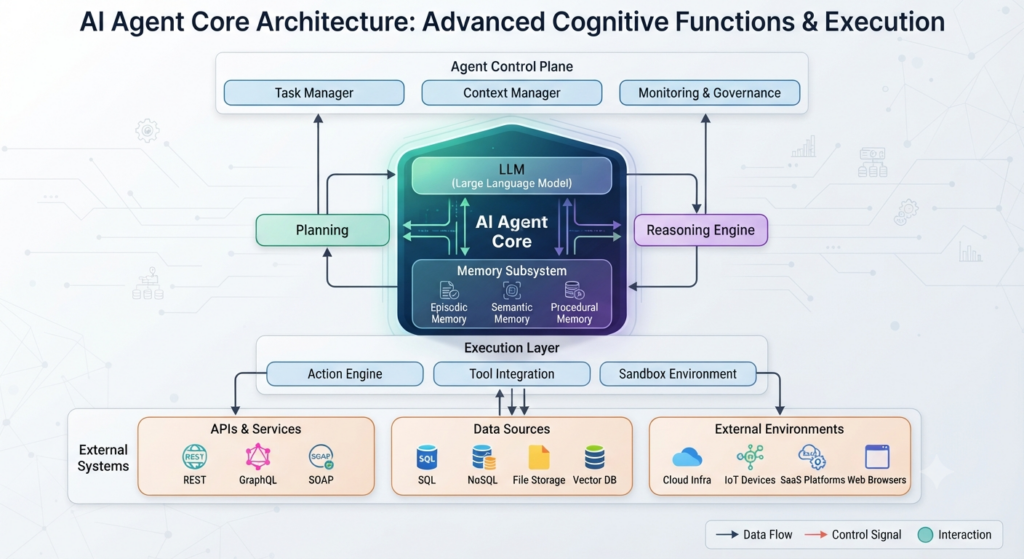
Most autonomous AI systems consist of several interconnected components.
1. Large Language Model (LLM)
The language model acts as the “brain” of the agent.
It is responsible for:
- Understanding user requests
- Reasoning
- Planning
- Decision making
- Natural language generation
Popular models include:
- OpenAI GPT models
- Anthropic Claude
- Google Gemini
- DeepSeek
- Llama
- Mistral
- Qwen
2. Memory
Memory allows an AI agent to maintain context over time.
Without memory:
- every conversation starts from scratch.
With memory:
- previous conversations are remembered,
- ongoing projects remain consistent,
- user preferences are retained,
- workflows continue across sessions.
Modern systems often combine:
- Short-term memory
- Long-term memory
- Vector databases
- Knowledge retrieval systems
3. Planner
The planner transforms a high-level goal into smaller executable tasks.
Example:
Goal:
Launch a new product.
Planning:
- Analyze competitors
- Research customers
- Create marketing strategy
- Design landing page
- Write blog content
- Prepare email campaign
- Schedule social media posts
Instead of solving everything at once, the planner creates an organized workflow.
4. Tool Manager
AI agents become powerful when they can interact with external tools.
Examples include:
- Email platforms
- Calendars
- Browsers
- Search engines
- Databases
- GitHub
- Slack
- CRM systems
- APIs
- Cloud storage
The tool manager selects the appropriate service for each task and executes the required action.
5. Reasoning Engine
The reasoning engine evaluates available information before acting.
Rather than following fixed instructions, it can:
- compare alternatives,
- estimate outcomes,
- identify risks,
- revise plans,
- choose the best solution.
Advanced reasoning enables AI agents to tackle open-ended and dynamic problems.
6. Execution Layer
Once a decision is made, the execution layer performs the task.
Examples include:
- sending emails,
- creating reports,
- updating spreadsheets,
- scheduling meetings,
- generating code,
- deploying applications,
- interacting with websites.
Execution transforms AI from an assistant into an active digital worker.
The AI Agent Lifecycle

Most AI agents operate through a continuous cycle.
Step 1 — Receive Goal
The user defines an objective.
Example:
“Create a complete content strategy for my company.”
Step 2 — Analyze
The agent identifies:
- constraints,
- available resources,
- required tools,
- missing information.
Step 3 — Plan
The objective is divided into manageable tasks.
Step 4 — Execute
The agent performs each task sequentially or in parallel, depending on the workflow.
Step 5 — Evaluate
Results are reviewed.
If improvements are needed, the agent revises its approach.
Step 6 — Learn
Relevant information is stored for future tasks.
This learning process enables increasingly personalized and efficient performance over time.
Types of AI Agents
Not all AI agents function in the same way.
Several architectural approaches are commonly used.
Simple Reflex Agents
These agents react immediately to predefined conditions.
Example:
If a server becomes unavailable, automatically restart the service.
They are fast but limited in flexibility.
Model-Based Agents
These agents maintain an internal representation of the environment.
They can make decisions using both current observations and stored knowledge.
Goal-Based Agents
Rather than reacting to events, these agents pursue specific objectives.
Example:
Increase website traffic by 30%.
They continuously evaluate progress until the goal is achieved.
Utility-Based Agents
These systems compare multiple possible actions and select the one with the highest expected benefit.
For example, they might balance:
- cost,
- speed,
- accuracy,
- resource usage,
- customer satisfaction.
Learning Agents
Learning agents improve through experience.
As they collect more data, they become more effective at planning and decision making.
Many modern enterprise AI systems combine learning capabilities with reasoning and memory.
Single-Agent vs Multi-Agent Systems
AI systems can operate independently or collaboratively.
Single-Agent Systems
One autonomous agent performs all tasks.
Advantages:
- Simpler architecture
- Easier deployment
- Lower operational complexity
Best suited for:
- personal assistants,
- coding assistants,
- customer support,
- research assistants.
Multi-Agent Systems
Multiple AI agents can collaborate in a multi-agent system to achieve complex objectives.
For example:
- Research Agent
- Planning Agent
- Writing Agent
- QA Agent
- Reviewer Agent
- Publishing Agent
Each agent has a dedicated responsibility while coordinating with others.
This architecture is increasingly adopted for enterprise automation because it scales more effectively than a single monolithic agent.
AI Agents and Model Context Protocol (MCP)
One of the most significant developments in modern AI agents is the adoption of the Model Context Protocol (MCP).
MCP provides a standardized way for AI agents to securely communicate with external tools, services, databases, and applications.
Instead of creating custom integrations for every system, developers can use MCP-compatible connectors to give AI agents access to a wide range of resources through a unified interface.
This standard improves interoperability, simplifies development, and enables agents to work across diverse software ecosystems more efficiently.
Real-World Applications of AI Agents
AI agents are rapidly transforming industries by automating complex workflows that previously required significant human effort. Rather than replacing professionals, they often act as intelligent collaborators, helping teams work faster and make better decisions.
Business Operations
Companies increasingly deploy AI agents to automate routine business processes such as:
- Managing customer inquiries
- Scheduling meetings
- Processing invoices
- Monitoring business performance
- Generating reports
- Managing internal knowledge bases
These agents can operate around the clock, reducing repetitive work while improving operational efficiency.
Marketing
Marketing teams use AI agents to:
- Research competitors
- Generate content ideas
- Write blog articles
- Create social media campaigns
- Produce advertising copy
- Optimize SEO strategies
- Analyze campaign performance
Instead of switching between multiple software tools, marketers can assign objectives to AI agents that coordinate the entire workflow.
Software Development
Developers increasingly rely on AI agents for:
- Writing code
- Refactoring projects
- Detecting bugs
- Running automated tests
- Reviewing pull requests
- Generating documentation
- Deploying applications
Modern coding agents can work alongside developers, significantly reducing development time while improving code quality.
Customer Support
Customer service teams use AI agents to:
- Answer customer questions
- Retrieve account information
- Escalate complex issues
- Generate support tickets
- Draft personalized responses
- Monitor customer satisfaction
Many businesses now operate hybrid support systems where AI handles routine requests while human agents focus on more complex cases.
Research and Knowledge Work
Researchers benefit from AI agents that can:
- Search academic literature
- Summarize publications
- Compare sources
- Generate citations
- Organize research notes
- Produce structured reports
These capabilities accelerate knowledge discovery without replacing critical human judgment.
Popular AI Agent Platforms in 2026

Several AI agent platforms make it easier to build and deploy autonomous AI agents.
OpenAI Agents SDK
OpenAI’s framework enables developers to create production-ready AI agents with tool integration, memory, and structured workflows.
Best for:
- Enterprise applications
- API integrations
- Custom assistants
LangGraph
LangGraph specializes in building stateful, graph-based AI workflows.
Key strengths include:
- Persistent memory
- Complex branching logic
- Multi-step reasoning
- Production scalability
CrewAI
CrewAI focuses on collaborative multi-agent systems where specialized agents work together to complete larger objectives.
Ideal for:
- Content production
- Business automation
- Research pipelines
- Team-based AI workflows
Microsoft AutoGen
AutoGen enables multiple AI agents to communicate, coordinate, and solve complex tasks collaboratively.
Common use cases include:
- Coding assistants
- Enterprise automation
- Research systems
- Autonomous workflows
Semantic Kernel
Developed by Microsoft, Semantic Kernel combines traditional programming with AI capabilities, making it easier to integrate language models into enterprise software.
Benefits of AI Agents
Organizations adopt AI agents because they offer several important advantages.
Increased Productivity
AI agents automate repetitive work, allowing employees to focus on higher-value activities.
Continuous Operation
Unlike human workers, AI agents can operate 24/7 without interruption.
Improved Decision Making
Advanced reasoning models help evaluate multiple alternatives before selecting the best solution.
Workflow Automation
Agents can coordinate multiple software platforms within a single workflow.
Scalability
Businesses can deploy hundreds or even thousands of AI agents simultaneously across different departments.
Personalization
Memory enables AI agents to adapt responses based on user preferences and historical interactions.
Challenges and Limitations
Despite rapid progress, AI agents still face several important challenges.
Hallucinations
Language models can occasionally generate inaccurate or fabricated information.
Critical decisions should always include human review.
Security Risks
Granting AI agents access to emails, databases, financial systems, or cloud infrastructure requires robust authentication and permission controls.
Organizations should follow the principle of least privilege and continuously monitor agent activity.
Privacy
AI agents often process sensitive business information.
Compliance with privacy regulations and secure data handling practices remains essential.
Cost
Running advanced language models, vector databases, and multiple integrated tools can become expensive at scale.
Organizations should carefully evaluate infrastructure and API costs before large-scale deployment.
Human Oversight
Fully autonomous systems remain unsuitable for many high-stakes scenarios.
Human supervision is still essential for legal, financial, healthcare, and strategic business decisions.
The Future of AI Agents
Industry experts expect AI agents to become increasingly capable over the next few years.
Emerging trends include:
- More advanced reasoning models
- Persistent long-term memory
- Better planning capabilities
- Native multi-agent collaboration
- Improved tool interoperability through standards such as MCP
- Enterprise-wide AI workforces
- Autonomous business process automation
Rather than replacing all human workers, AI agents are likely to become intelligent collaborators that augment productivity across virtually every industry.
Frequently Asked Questions (FAQ)
What is an AI agent?
An AI agent is an autonomous software system that can perceive information, reason, plan, and perform actions to achieve specific goals with minimal human intervention.
How is an AI agent different from a chatbot?
Traditional chatbots primarily respond to user prompts, whereas AI agents can execute multi-step workflows, use external tools, maintain memory, and make autonomous decisions.
What technologies power AI agents?
Modern AI agents typically combine:
- Large Language Models (LLMs)
- Memory systems
- Planning modules
- Reasoning engines
- Tool integrations
- APIs
- Vector databases
Can AI agents work together?
Yes. Multi-agent systems allow specialized AI agents to collaborate on complex tasks by sharing information and coordinating their actions.
Are AI agents replacing human workers?
In most cases, AI agents are designed to augment human capabilities rather than replace them. They automate repetitive tasks while enabling professionals to focus on strategic and creative work.
Conclusion

AI agents represent one of the most significant advancements in artificial intelligence. By combining reasoning, planning, memory, and tool usage, they move beyond simple conversational AI and become capable of completing complex real-world tasks autonomously.
As standards such as the Model Context Protocol (MCP) improve interoperability and leading frameworks like LangGraph, CrewAI, AutoGen, and the OpenAI Agents SDK mature, AI agents are expected to become a core part of modern software and business operations.
Whether you’re a developer, business leader, or AI enthusiast, understanding how AI agents work today will help you prepare for a future where autonomous systems increasingly collaborate with humans to solve complex problems.
INTERNAL LINKS
- What Is Model Context Protocol? (2026): The Complete Guide — https://vynula.com/what-is-model-context-protocol/
- What Is Agentic AI? (2026): The Complete Beginner’s Guide — https://vynula.com/what-is-agentic-ai/
- What Is AI Workflow Automation? (2026): The Complete Beginner’s Guide — https://vynula.com/what-is-ai-workflow-automation/
- Best AI Workflow Tools in 2026 — https://vynula.com/best-ai-workflow-tools-2026/
- Best AI Coding Tools (2026): The Ultimate Guide for Developers — https://vynula.com/best-ai-coding-tools/
- ChatGPT Models Explained (2026): Complete Guide to OpenAI’s AI Models — https://vynula.com/chatgpt-models-explained/
- Claude AI Models Explained (2026): Choosing Between Haiku, Sonnet, Opus & Claude Code — https://vynula.com/claude-ai-models-explained/
- Gemini Models Explained (2026): Complete Guide to Google’s AI Model Family — https://vynula.com/gemini-models-explained/
EXTERNAL / OFFICIAL SOURCES
- OpenAI — https://openai.com/
- OpenAI Platform Documentation — https://platform.openai.com/docs/
- Anthropic — https://www.anthropic.com/
- Google AI — https://ai.google/
- Model Context Protocol — https://modelcontextprotocol.io/
- LangGraph Documentation — https://langchain-ai.github.io/langgraph/
- CrewAI — https://www.crewai.com/
- Microsoft AutoGen — https://microsoft.github.io/autogen/
- Microsoft Semantic Kernel — https://learn.microsoft.com/semantic-kernel/