



Introduction
“AI employee” sounds like marketing language, and in plenty of cases it still is. But behind the term is a real and fast-moving shift: enterprises are no longer just giving staff AI tools to use — they’re deploying autonomous agents that independently own a task or process end to end, the way a team member would. Adoption forecasts vary widely by vendor and research methodology, so this guide focuses on observable capabilities, governance requirements and deployment patterns rather than treating headline projections as settled fact. This guide explains what an AI employee actually is, how it differs from a chatbot or traditional automation, the governance challenges enterprises are running into, and where the real value shows up today.
Table of Contents
- What Is an AI Employee?
- AI Employee vs. Chatbot vs. RPA: What’s Actually Different
- The SuperWorker Model: How Human Roles Are Shifting
- Governance: Agent System of Record and Agentic Identity
- The Coordination Gap: Why Half of Enterprise Agents Work Alone
- Real-World Results
- Choosing Where to Deploy an AI Employee: A Practical Framework
- FAQ
1. What Is an AI Employee?
An AI employee (also called a digital employee or digital worker) is an autonomous AI agent that independently executes a complex task or an entire process end to end, acting as something closer to a virtual team member than a tool a person operates. The defining trait isn’t intelligence — it’s scope and autonomy: an AI employee owns an outcome, not just a single response to a single prompt.
2. AI Employee vs. Chatbot vs. RPA: What’s Actually Different
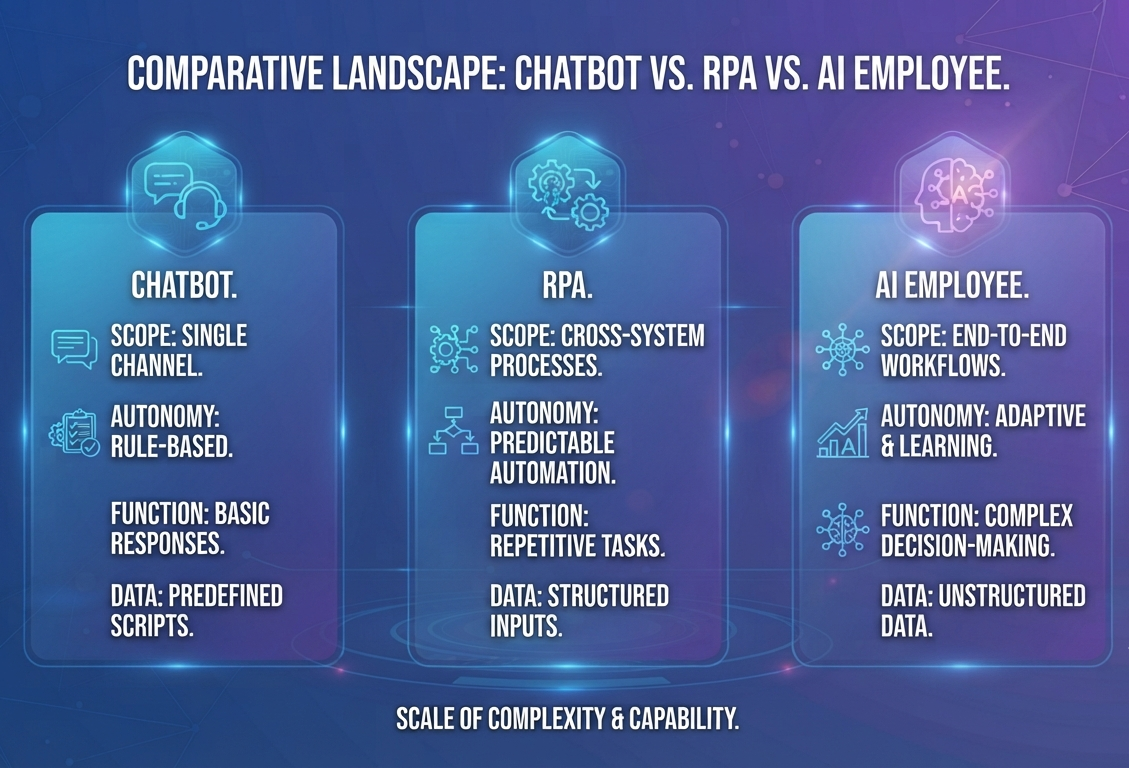
A chatbot answers questions inside a single conversation and has no persistent ownership of a task once the conversation ends. Traditional Robotic Process Automation (RPA) executes a fixed, pre-scripted sequence of steps and breaks the moment the underlying system or process changes. An AI employee sits above both: it reasons about a goal, plans a sequence of actions to achieve it, executes across multiple systems, and adapts when something doesn’t go as expected — much closer to how a human employee would handle an open-ended assignment than either a chatbot or an RPA script.
3. The SuperWorker Model: How Human Roles Are Shifting
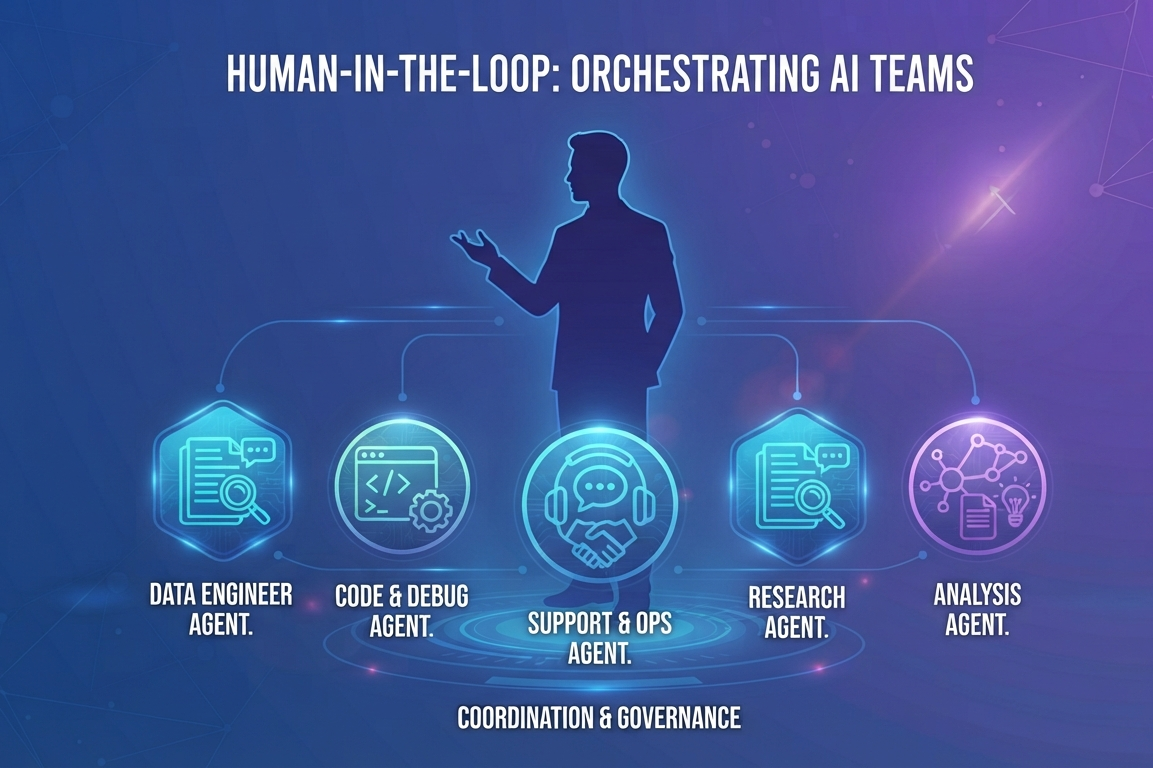
The emerging organizational model in 2026 isn’t “AI replaces employees” so much as “humans orchestrate a team of digital agents” — sometimes called the SuperWorker model. Under this model, a single human increasingly directs and reviews the output of multiple AI employees rather than doing every task by hand, with the productivity gain coming from that shift in role rather than from headcount reduction alone. Proponents of this model project meaningful productivity multipliers as human work shifts from execution toward strategic alignment, quality review, and exception-handling — though the scale of that gain naturally varies a great deal by function and by how mature the underlying agent deployment actually is.
4. Governance: Agent System of Record and Agentic Identity
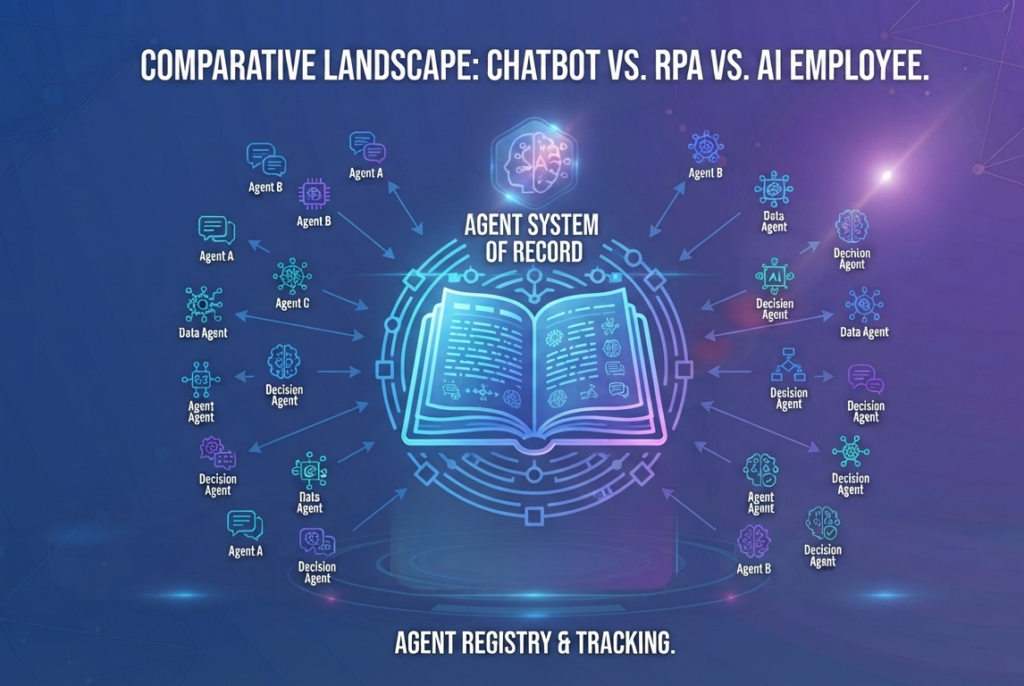
As AI employees take on real responsibility, enterprises are running into a genuinely new governance problem: most organizations currently lack visibility into how many AI agents they actually have running and what each one is authorized to do — commonly described as an “Agentic Identity” visibility gap. The proposed fix taking shape in 2026 is a formal Agent System of Record (ASOR): a structured inventory of every deployed agent, its permissions, and its activity, tracked with the same rigor traditionally reserved for human staff records. This isn’t a hypothetical concern — regulatory frameworks like the EU AI Act are already establishing corporate liability for the actions autonomous agents take on a company’s behalf, which makes this kind of tracking a compliance requirement rather than just good practice.
5. The Coordination Gap: Why Half of Enterprise Agents Work Alone
A notable finding from 2026 enterprise research: the average organization now runs roughly a dozen AI agents, but close to half of them operate in isolation, without connecting to other agents or systems. This matters because it caps what any individual agent can accomplish — an AI employee that can’t coordinate with the other agents or tools around it is stuck doing a narrower slice of a process than the “employee” framing implies. Enterprises that connect their agents (through protocols like MCP for tool/data access, or A2A for agent-to-agent communication) are seeing meaningfully more value than those running isolated, single-purpose agents.
6. Real-World Results
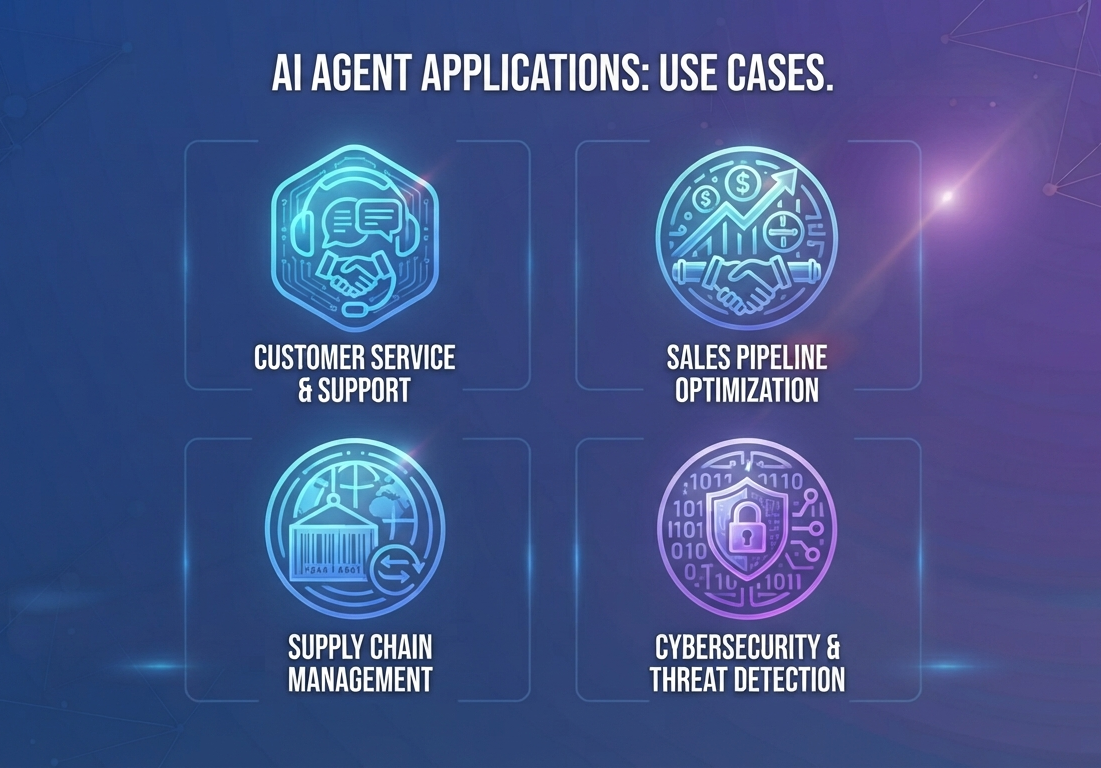
Customer service. Enterprises deploying AI employees in customer support have reported meaningful gains in case resolution rates — driven largely by an agent’s ability to handle a full resolution path rather than escalating at the first sign of complexity.
Go-to-market operations. Some enterprise platforms now deploy dozens of specialized AI agents across a single go-to-market organization, with individual case studies reporting millions of dollars in generated sales pipeline attributable to agent-driven prospecting and qualification work.
Supply chain and operations. AI employees are increasingly used in cybersecurity monitoring, sales operations, and supply chain management — domains where a persistent, always-on agent that can act across systems has a clear advantage over both a periodic human check-in and a rigid automation script.
7. Choosing Where to Deploy an AI Employee: A Practical Framework
- Does the task require ownership of an outcome, not just a single response? If yes, an AI employee framing fits better than a chatbot.
- Does the process change often enough that a fixed RPA script would keep breaking? An AI employee’s ability to adapt earns its extra complexity here.
- Can you actually track what this agent is authorized to do? Don’t deploy an AI employee into a sensitive process without an Agent System of Record in place first — this is where the real governance risk sits.
- Does this agent need to coordinate with other agents or systems to actually finish the job? If so, invest in the connective layer (MCP, A2A) up front rather than deploying it in isolation and hoping it’s enough.
- Is human oversight built in at the right checkpoints? The SuperWorker model works because humans still review and course-correct — not because agents run entirely unsupervised.
FAQ
Is an “AI employee” actually a full replacement for a human employee? Not typically, and not yet in most deployments. The more accurate framing in 2026 is that AI employees take end-to-end ownership of specific tasks or processes, while humans shift toward orchestration, strategic direction, and quality review — the SuperWorker model — rather than being removed from the loop entirely.
What’s the difference between an AI employee and RPA? RPA executes a fixed, pre-scripted sequence of steps and breaks when the underlying process or system changes. An AI employee reasons about a goal and adapts its actions when circumstances change, which is what lets it handle more open-ended work than a traditional automation script.
Why do enterprises need an Agent System of Record? Because most organizations currently don’t have visibility into how many AI agents are running or what each one is authorized to do. As regulations like the EU AI Act establish liability for autonomous agent actions, tracking this with the same rigor as human staff records becomes a real compliance requirement, not just good hygiene.
Why do so many enterprise AI agents work in isolation? Largely because many organizations deployed individual agents for specific point tasks before investing in the connective layer (protocols like MCP or A2A) that would let those agents share context or hand off work to each other — leaving roughly half of deployed agents unable to coordinate with anything else.
Conclusion
AI employees represent a genuine shift from tools that assist a human to agents that own an outcome — but 2026’s honest picture is one of uneven maturity: real productivity gains in customer service and go-to-market functions, alongside a governance gap (Agentic Identity, Agent System of Record) and a coordination gap that leaves close to half of deployed agents working in isolation. The organizations getting real value aren’t the ones deploying the most agents — they’re the ones that pair deployment with proper tracking, connective infrastructure, and clear human checkpoints.
Related Vynula Guides
Official Source Package
- Gartner (enterprise agent adoption data, referenced) — https://www.gartner.com/
- Forrester (2026 predictions, referenced) — https://www.forrester.com/