




Introduction
Ask an AI agent to fix a bug on Monday, and by Tuesday it has forgotten your codebase, your preferences, and every decision you made together. This is the single biggest gap between today’s AI agents and something that actually feels like a colleague: memory. In 2026, “AI memory systems” have become their own infrastructure category — a layer that sits between the language model and the agent’s actions, deciding what gets remembered, how it’s stored, and how it’s recalled months later.
This guide breaks down how AI memory systems actually work, the main architectural approaches in production today, the leading AI memory systems on the market, and how to think about choosing one for your own agent.
Table of Contents
- What Is an AI Memory System?
- Why Context Windows Aren’t Memory
- The Three Memory Architectures in Production
- Leading AI Memory Tools in 2026
- How AI Agents Decide What to Remember
- Choosing a Memory System: A Practical Framework
- Real-World Use Cases
- Limitations and Open Problems
- FAQ
1. What Is an AI Memory System?
AI memory systems are infrastructure that let an agent persist information across sessions — facts about a user, decisions made in a past conversation, or the state of a long-running task — and retrieve the relevant pieces when needed, without re-reading an entire history every time. Without them, every conversation starts from zero, no matter how much context was built up before.
2. Why Context Windows Aren’t Memory
It’s tempting to think a bigger context window solves this problem. It doesn’t, for two reasons. First, cost and latency scale with every token you stuff into a prompt — replaying months of history on every turn is neither cheap nor fast. Second, relevance gets diluted: a model asked to reason over 200,000 tokens of mostly-irrelevant history performs worse than one given the 500 tokens that actually matter. Memory systems solve this by doing the selection work in advance — extracting, storing, and retrieving only what’s relevant to the current moment.
3. The Three Memory Architectures in Production
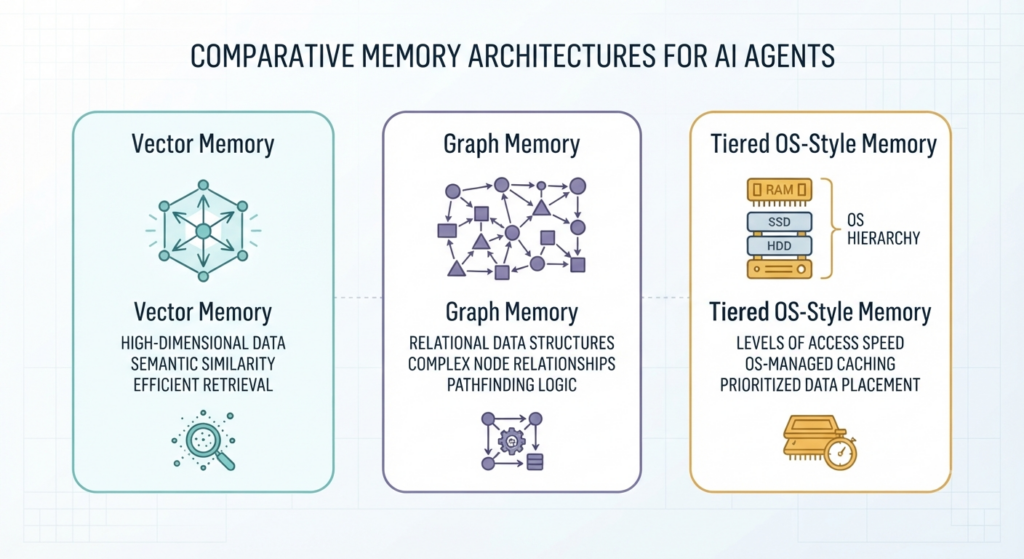
Vector-based memory. The most common approach: conversations are broken into facts, each fact is embedded and stored in a vector database, and at query time the system retrieves the entries most semantically similar to what’s being discussed. This is lightweight and framework-agnostic, which is why it’s the default starting point for most teams.
Graph-based memory. Instead of (or alongside) vector similarity, facts are stored as entities and relationships in a knowledge graph. This handles a category of question vector search struggles with: how something changed over time, or how two facts relate to each other. The tradeoff is real — running a graph database is more operational overhead than a vector store.
OS-inspired tiered memory. A third model treats the agent’s context window like RAM in a computer: a small “core memory” block always lives in context and the agent can read and write it directly, while a much larger “archival memory” sits outside the context window and is queried on demand, the way a program pages data in from disk. This approach gives the agent more direct control over what it keeps close at hand versus what it stores away.
None of these three is strictly better — production AI memory systems increasingly combine more than one architecture, since vector similarity and relationship-based retrieval solve different problems.
4. Leading AI Memory Tools in 2026
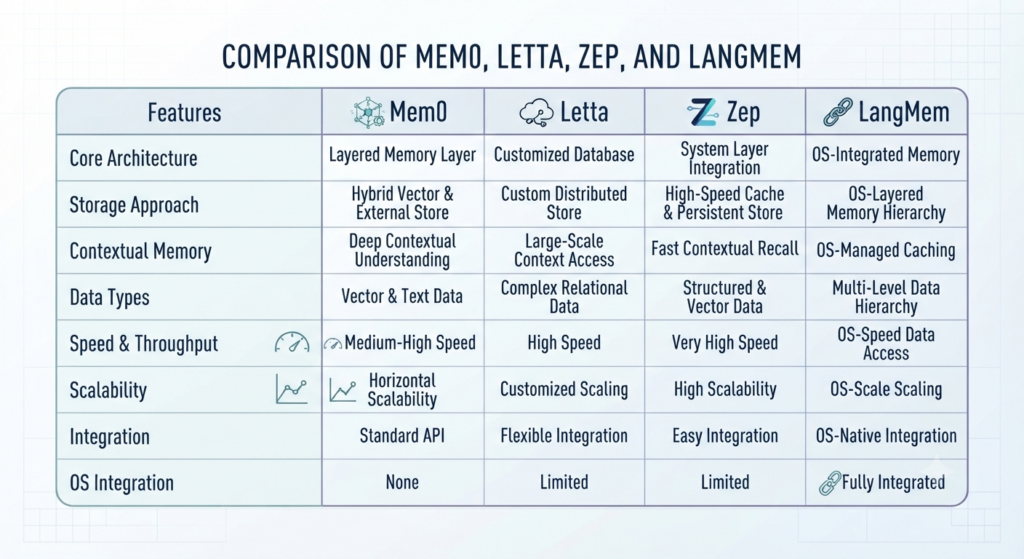
Several companies now build dedicated AI memory systems as their core product, rather than treating memory as a side feature of an agent framework.
- Mem0 — a framework-agnostic memory layer that extracts facts from conversations and stores them for semantic retrieval. It plugs into whatever agent stack you’re already using (LangChain, CrewAI, AutoGen, or a custom loop) rather than requiring you to adopt a new runtime.
- Letta (formerly MemGPT) — grew out of a UC Berkeley research project and is now a full agent runtime built around the OS-inspired tiered memory model described above. Agents run inside Letta rather than bolting it on.
- Zep — builds a temporal knowledge graph from conversation history, combining graph traversal with vector search. It’s the strongest option when an agent needs to reason about how facts changed over time or resolve contradictions.
- LangMem — LangChain’s memory SDK, built specifically for teams already standardized on LangGraph.
- Managed vector stores (Pinecone, Qdrant, pgvector) — the storage layer underneath a memory platform like Mem0 or Zep, or a simple direct option for teams with straightforward retrieval needs.
The practical pattern in most production stacks: a dedicated memory platform (Mem0 or Zep) handles extraction and retrieval logic, backed by a vector or graph database underneath for actual storage.
5. How AI Agents Decide What to Remember
Regardless of architecture, most AI memory systems follow a similar loop: during a conversation, the memory layer extracts discrete facts (a preference, a decision, a piece of project context), stores each one indexed by user, session, and agent, and at the start of a new session retrieves the entries most relevant to what’s being discussed — using semantic similarity, keyword matching, or graph traversal depending on the architecture. Some systems go further and self-edit: when a new fact conflicts with a stored one, the memory is updated in place rather than just appended, so the agent doesn’t end up holding two contradictory “truths” at once.
6. Choosing a Memory System: A Practical Framework
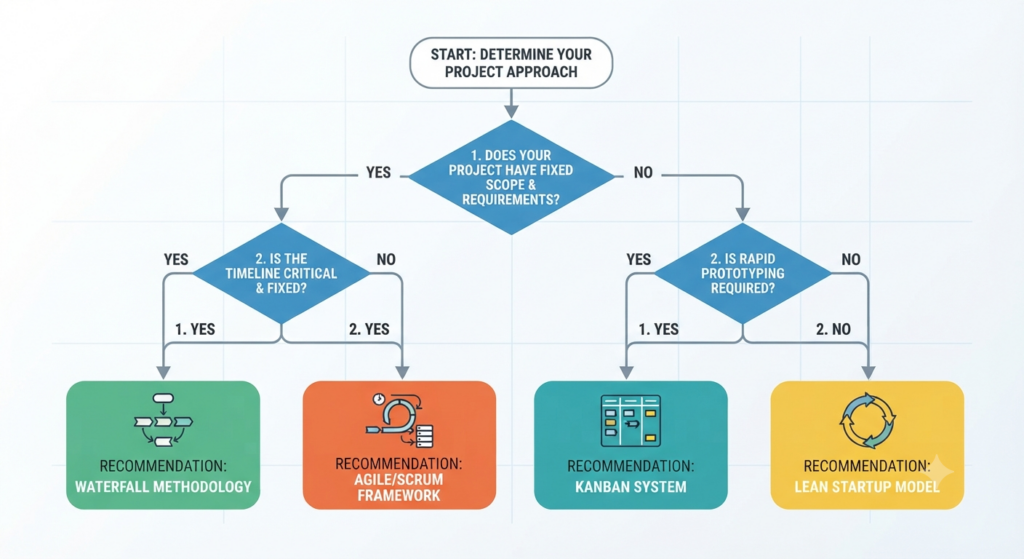
Ask three questions before picking a tool:
- Do you need time-awareness? If your agent has to answer “what was true when,” or reason about how a fact changed, a graph-based system like Zep earns its extra operational cost. If not, a simpler vector-based layer like Mem0 is faster to ship.
- Do you want a memory layer, or a full agent runtime? Mem0-style tools bolt onto your existing agent framework. Letta asks your agents to run inside its platform. That’s a bigger architectural commitment, and worth it mainly when you want the agent itself to have fine-grained control over what it remembers.
- What’s your operational appetite? A graph database is more infrastructure to run and maintain than a hosted vector store. For a small team or an early-stage product, starting with the lightest option and upgrading later is usually the safer path.
7. Real-World Use Cases
AI memory systems already show up across a range of production agent deployments:
Customer support agents. A support agent that remembers a customer’s past tickets, product version, and previous troubleshooting steps can skip re-asking questions the customer already answered last week — this is one of the most common production deployments of memory platforms like Mem0.
Coding assistants. An agent that spends twenty turns learning a codebase’s structure, a team’s naming conventions, and a developer’s preferences loses all of that the moment the session ends unless it’s backed by persistent memory. Several coding-focused agent frameworks now ship with memory layers specifically so that context survives across work sessions, not just within one.
Personal and research assistants. Agents that track a user’s ongoing projects, reading interests, or long-running research questions rely on memory to build up a picture over weeks or months rather than treating every conversation as the first.
Multi-agent systems. When several agents collaborate on a task, a shared memory layer lets one agent’s findings become available to another without re-running the same research — this is increasingly common in agent frameworks like LangGraph and CrewAI, where multiple specialized agents hand off work.
8. Limitations and Open Problems
Memory systems are still young infrastructure, and the honest caveats matter:
- Benchmarks aren’t standardized. Different vendors report results on different evaluation sets, so a headline accuracy number from one provider isn’t directly comparable to another’s.
- Retrieval isn’t free. Every memory system adds a lookup step before the model can respond, which is latency your users feel.
- Wrong memories are worse than no memory. A system that confidently retrieves an outdated or incorrect fact can mislead an agent more than one with no memory at all — which is why self-editing and conflict resolution matter as much as raw retrieval accuracy.
Conclusion
AI memory systems have moved from an academic curiosity (the original MemGPT paper) to a real infrastructure decision every team building agents now has to make. There’s no single correct answer — the right architecture depends on whether your agent needs to reason about time, how much operational complexity you can take on, and whether you want a lightweight add-on or a full runtime. Starting simple with a vector-based layer and adding graph or tiered memory only when a concrete use case demands it is the most common — and most defensible — path in production today.
FAQ
What’s the difference between AI memory and a longer context window? A longer context window lets a model see more text at once, but every token still costs latency and money, and irrelevant history dilutes the model’s focus. AI memory systems solve this by doing the filtering in advance, storing facts externally and retrieving only what’s relevant to the current moment.
Is Mem0 or Letta better for a new project? Mem0 is faster to add to an existing agent stack since it’s framework-agnostic. Letta is a deeper architectural commitment — your agent runs inside its runtime — and makes more sense when you want the agent itself managing what it keeps in context versus in archival storage.
Do I need a graph database for AI agent memory? Only if your agent needs to reason about how facts changed over time or resolve contradictions between them. For straightforward conversational recall and personalization, a vector-based system is simpler to run and sufficient for most use cases.
Can AI memory systems make mistakes? Yes — a memory system can retrieve an outdated or incorrect fact just as confidently as a correct one. This is why systems that self-edit or resolve conflicts between contradictory facts are considered more reliable than ones that simply append every new fact indefinitely.
Can I use more than one memory architecture at once? Yes, and in practice many production systems do — pairing a vector store for fast semantic recall with a graph layer for relationship and time-based reasoning is a common combination rather than an either/or choice.
Does adding memory slow down an AI agent? It adds a retrieval step before the model generates a response, so there’s some latency cost. Well-designed memory systems keep this overhead small by retrieving only a handful of relevant facts rather than searching an entire history, but it’s a real tradeoff worth measuring on your own workload rather than assuming it away.p before the model generates a response, so there’s some latency cost. Well-designed memory systems keep this overhead small by retrieving only a handful of relevant facts rather than searching an entire history, but it’s a real tradeoff worth measuring on your own workload rather than assuming it away.
Related Vynula Guides
Official Source Package
- Mem0 — https://mem0.ai/
- Letta — https://www.letta.com/
- Zep — https://www.getzep.com/
- LangChain (LangMem) — https://www.langchain.com/