




Google is taking another major step toward turning Gemini into a true AI assistant—and some users are excited while others are raising privacy concerns.
With the latest Google Chrome update, Gemini is gaining the ability to understand exactly what you’re looking at on your screen. The new feature, called “Select from Screen,” eliminates the need for screenshots, copy-pasting, or lengthy explanations when asking AI for help.
Instead, users can simply highlight a section of a webpage and instantly send it to Gemini for analysis.
As AI assistants become increasingly integrated into everyday computing, this update could mark one of the biggest shifts yet in how people interact with artificial intelligence.
Gemini Screen Selection Changes How Users Interact With AI
For years, users have relied on screenshots and manual descriptions when asking AI to analyze content found online.
Google’s new Gemini screen selection feature changes that workflow completely.
How the Feature Works
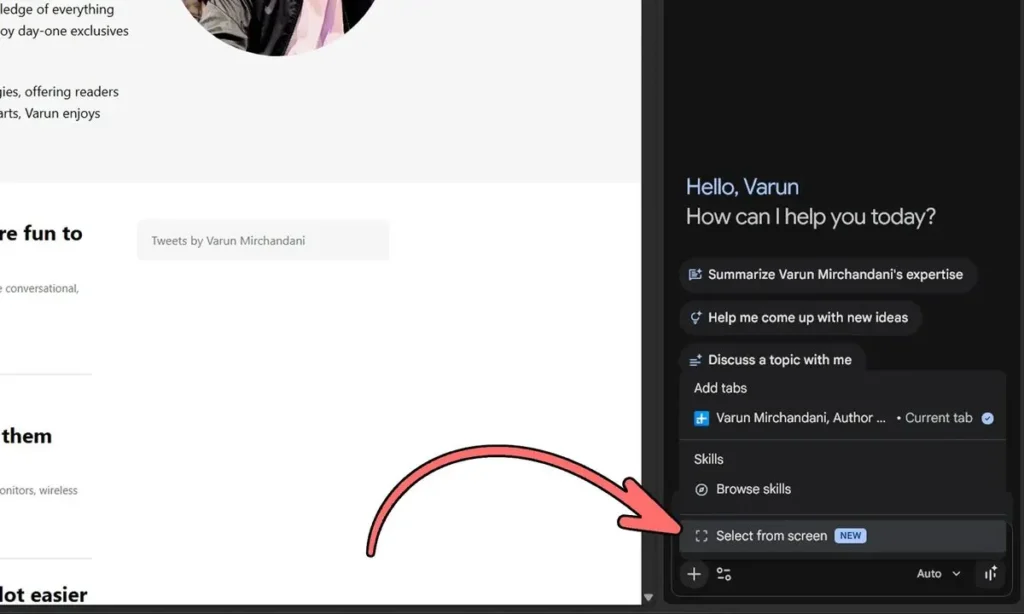
The tool appears inside Chrome’s “+” menu and functions like a built-in screen clipping utility.
Users can:
- Highlight text
- Select images
- Capture specific sections of a webpage
- Instantly send content to Gemini
Once selected, the information becomes available to Gemini, allowing the AI assistant to analyze exactly what the user is viewing.
This means users no longer need to explain context manually.
Instead of writing:
“Can you explain the graph located in the middle of this webpage?”
Users can simply select the graph and ask:
“Explain this.”
Goodbye to Screenshots and Copy-Paste
One of the biggest advantages is efficiency.
Traditional AI workflows often require:
- Taking a screenshot
- Uploading the image
- Writing instructions
- Waiting for analysis
The new feature removes several of those steps entirely.
For students, researchers, developers, and everyday users, this could significantly streamline interactions with AI.
Google Wants Gemini to Become More Than a Chatbot
Google’s broader goal appears to be much bigger than improving browser convenience.
The company is steadily transforming Gemini from a question-and-answer chatbot into a proactive digital assistant.
Understanding User Context
One limitation of current AI assistants is context.
Users frequently have to explain:
- What they’re viewing
- What they’re working on
- What part of a document matters
The new screen selection system reduces this friction by giving Gemini direct access to relevant information.
This allows the AI to understand user intent more naturally.
A Step Toward Agentic AI
Industry experts increasingly believe that the future of AI lies in “agentic” systems—assistants capable of understanding environments and taking actions.
Google’s latest move aligns perfectly with that vision.
Rather than waiting for detailed instructions, Gemini can now interpret selected content and provide immediate assistance.
Chrome 149 Introduces the New Capability

Google has begun rolling out the feature with Chrome version 149.
How to Access It
Users who receive the update can:
- Open Chrome
- Click the “+” menu
- Select content from the screen
- Send it directly to Gemini
In many cases, simply restarting the browser after updating is enough to activate the feature.
As with most Chrome releases, availability may vary by region and account.
Mobile and Desktop Implications
The feature could become especially valuable on mobile devices, where copy-pasting information between apps can be cumbersome.
By allowing users to point directly at content, Google is simplifying AI interactions across platforms.
Gemini May Soon Be Able to Analyze Entire Screens
The screen selection feature wasn’t the only announcement made by Google.
The company also revealed that developers will gain new tools allowing Gemini to view, analyze, and interact with computer screens.
From Observation to Action
This represents a major evolution in AI capabilities.
Future Gemini-powered applications could potentially:
- Analyze workflows
- Assist with software tasks
- Navigate applications
- Perform actions on behalf of users
In other words, Gemini may eventually become capable of understanding not just selected content but entire digital environments.
The Rise of AI Agents
This development follows a growing industry trend.
Companies across the AI sector are racing to build autonomous assistants capable of completing tasks rather than simply answering questions.
Google, OpenAI, Anthropic, and Microsoft are all investing heavily in agent-based AI systems.
The competition is quickly shifting from who has the smartest chatbot to who can build the most useful digital assistant.
Privacy Questions Are Already Emerging
As expected, giving AI deeper access to screens raises important privacy discussions.
What Can Gemini Actually See?
According to Google’s description, users must intentionally select content before sending it to Gemini.
The AI does not continuously monitor everything displayed on screen.
However, the broader vision of AI assistants that can observe and interact with applications will likely generate ongoing debates around transparency and user control.
Balancing Convenience and Privacy
Many users will welcome the convenience of instant AI analysis.
Others may question how much screen access future AI systems should have.
As AI assistants become more powerful, trust and privacy will become just as important as performance.
Conclusion
Google’s new Gemini screen selection feature could fundamentally change how users interact with AI inside Chrome.
By allowing Gemini to see exactly what users are viewing, Google removes many of the barriers that currently slow down AI-assisted workflows.
More importantly, this update signals a larger transformation. Google is no longer positioning Gemini as a simple chatbot. The company is building an intelligent assistant capable of understanding context, analyzing screens, and eventually helping users perform real-world digital tasks.
As AI competition intensifies in 2026, features like screen awareness may become the next major battleground between Google, OpenAI, Anthropic, and other AI leaders.