


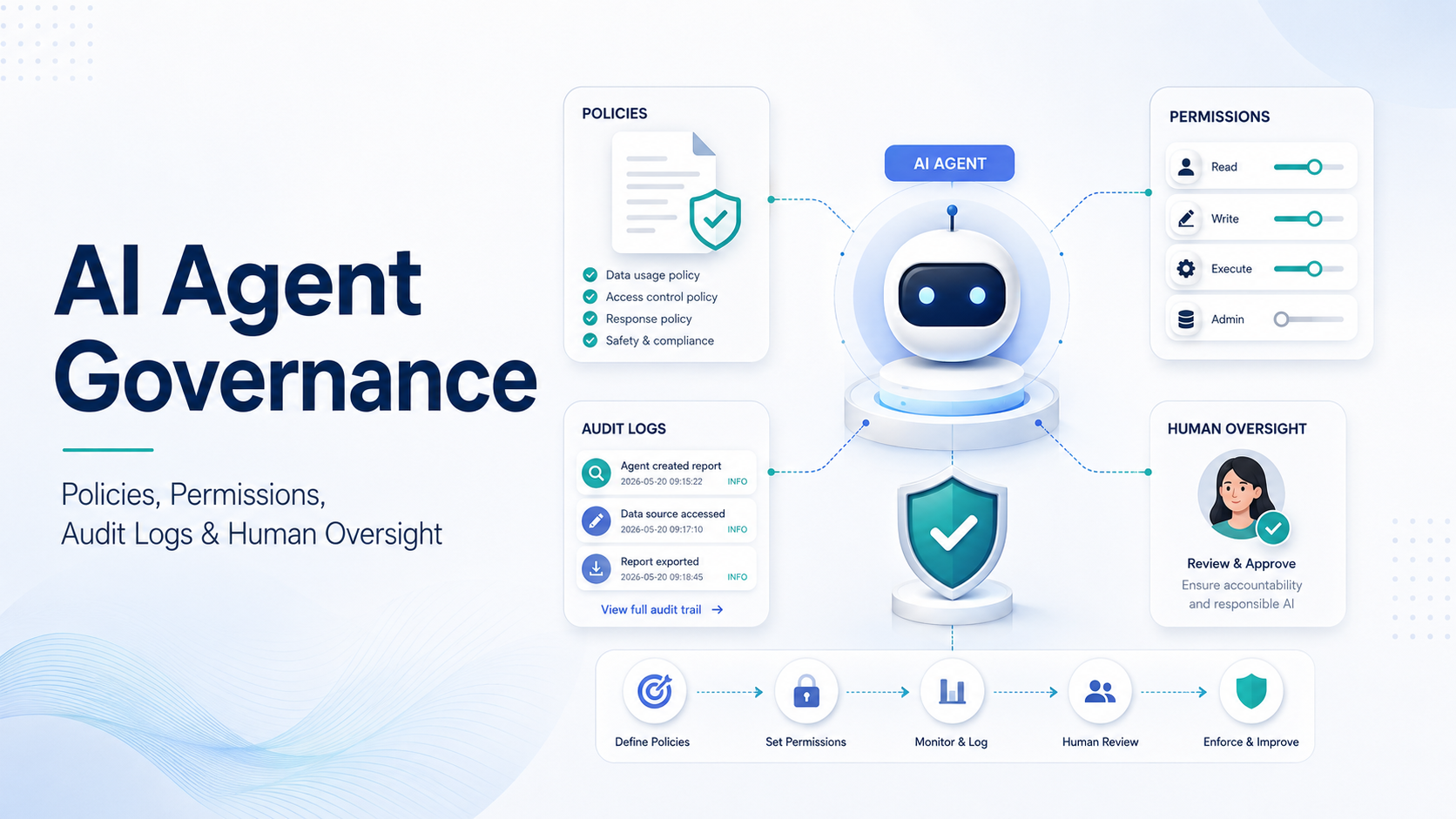
AI agent governance is the system of policies, technical controls, ownership rules, approval boundaries, monitoring, and lifecycle processes used to keep autonomous agents accountable. As agents gain access to APIs, business systems, files, credentials, communication channels, and other agents, governance determines what they are allowed to do, how that authority is enforced, who is responsible, and what happens when behavior moves outside expected limits.
In 2026, this is no longer a theoretical enterprise concern. Agents are moving from assistants that recommend actions to software actors that can execute them. That shift makes governance a runtime problem as much as a policy problem. A written rule that says an agent should not export customer data is useful, but production governance requires the system to technically prevent or interrupt that action when policy says no.
This guide explains AI agent governance from the production perspective: autonomy levels, identity, permissions, human oversight, policy enforcement, audit logs, agent inventories, kill switches, delegation, lifecycle controls, shadow agents, and the governance architecture required to operate agentic systems safely at scale.
What Is AI Agent Governance?
AI agent governance is the operating framework that defines how agents are created, approved, identified, authorized, monitored, reviewed, changed, and retired. It combines organizational accountability with technical enforcement.
Traditional AI governance often focuses on questions such as model risk, data quality, fairness, privacy, documentation, and responsible use. Those concerns still matter, but agents introduce an additional layer: action authority. An agent may not only generate an answer. It may send a message, change a record, deploy code, purchase a service, create another agent, or invoke tools across several systems in sequence.
Governance therefore has to answer questions such as:
- Who owns this agent?
- What business purpose is it approved for?
- Which identity does it use?
- Which tools, data and systems can it access?
- Which actions are read-only, approval-gated or autonomous?
- How is policy enforced at runtime?
- Which events must be logged?
- Who reviews exceptions and incidents?
- How quickly can the agent be paused, revoked or rolled back?
- Can the agent delegate work, and if so, how much authority can it pass on?
The goal is not to eliminate autonomy. The goal is to make autonomy bounded, observable and accountable.
Why AI Agent Governance Matters in 2026
The governance problem becomes more difficult as agents become more capable. A read-only research agent presents a different risk profile from an agent that can modify production configuration or initiate payments. Applying exactly the same controls to both can create two failures: simple agents become unnecessarily constrained, while high-autonomy agents may remain dangerously under-governed.
Gartner described this problem in 2026 as a need for proportional governance across different autonomy levels. Its framework distinguishes agents that observe, advise, act with approval, and act autonomously. The important idea is not the labels themselves; it is that governance intensity should rise with action authority and consequence.
PwC similarly argues that production agents should have verified identity, defined roles, task-specific permissions, auditable activity and clear limits on autonomous action. Human oversight should increase as the consequences of agent actions increase.
This is also becoming a standards issue. The NIST AI Agent Standards Initiative focuses on secure, interoperable agents that can act on behalf of users, while the OWASP GenAI Security Project has expanded its work from agentic risk catalogs into practical governance and runtime-control guidance.
AI Agent Governance vs AI Agent Security
Governance and security overlap, but they are not identical.
AI agent security asks how to prevent compromise, prompt injection, credential theft, unsafe tool execution, data leakage and privilege escalation. AI agent governance asks the broader operating questions: who may deploy an agent, who owns it, what risk class it belongs to, which actions are approved, how controls are enforced, how evidence is retained, and when the agent must be reviewed or retired.
Security is one control domain inside governance. Other governance domains include compliance, accountability, lifecycle management, financial controls, data boundaries, human approval, quality assurance and change management.
For the technical security layer, see Vynula’s AI Agent Security in 2026 guide.
Govern Agents According to Their Autonomy Level
A practical governance program should classify agents by what they can actually do, not by marketing labels or model capability.
Level 1: Observe
An observe agent can read approved information and produce output for a user, but cannot modify external systems. Typical controls include authenticated access, scoped data permissions, logging and baseline security testing.
Level 2: Advise
An advise agent can generate recommendations, drafts or proposed actions, but a human still performs the actual change. Governance should add output-quality evaluation, domain-specific testing and clear user guidance about appropriate reliance.
Level 3: Act With Approval
This agent can execute actions, but consequential operations require explicit human approval. Governance now needs strong approval workflows, detailed action previews, audit trails, tool-level permission checks and incident-response procedures.
Level 4: Act Autonomously
An autonomous production agent can execute actions inside defined guardrails without approval for every step. Governance must therefore become continuous: runtime policy enforcement, monitoring, exception handling, rapid revocation, rollback, spending or rate limits, and circuit breakers that can stop the agent when thresholds are crossed.
Start With an Agent Inventory and Named Ownership
You cannot govern agents you cannot identify. A mature program starts with a centralized inventory of production agents, experimental agents that can reach sensitive systems, third-party agents, and agent identities created inside SaaS platforms.
Each inventory record should include:
- agent name and unique identifier;
- business purpose;
- accountable owner or sponsor;
- development team;
- environment and deployment status;
- autonomy level;
- model and framework;
- connected tools and MCP servers;
- data classifications accessible to the agent;
- identity and credential type;
- approved permissions;
- human-approval requirements;
- risk classification;
- last security and governance review;
- incident and rollback contacts.
Ownership matters because an autonomous system cannot be the final accountable party. Someone in the organization must have authority to approve changes, receive alerts, revoke access and explain why the agent exists.
Give Every Production Agent a Verifiable Identity
Governance becomes difficult when multiple agents share one generic service account or API key. Shared credentials make it harder to determine which agent performed an action, who delegated authority, and which access should be revoked after an incident.
Production governance should therefore treat agents as first-class principals wherever infrastructure supports it. Each important agent or workload should have a unique identity, an accountable owner and permissions tied to its approved purpose.
Microsoft’s 2026 guidance on least privilege for agents emphasizes task-scoped roles, explicit scopes, tool allowlists, time-limited elevation, downstream authorization checks and end-to-end auditability. NIST has also highlighted identification and authorization as foundational requirements for software and AI agents.
Vynula’s AI Agent Identity and Authentication Explained covers workload identity, OAuth, short-lived credentials, delegation and MCP authorization in detail.
Use Least Privilege Instead of Permanent Broad Access
An agent should not receive every permission it could possibly need in the future. Governance should grant the smallest practical authority for the current workload.
Least-privilege design can include:
- read-only access by default;
- resource-specific roles rather than tenant-wide roles;
- tool allowlists;
- action allowlists inside tools;
- separate read and write scopes;
- short-lived credentials;
- just-in-time elevation;
- spending limits;
- rate and volume limits;
- environment boundaries;
- data-classification restrictions;
- approval requirements for high-risk operations.
This matters because agent workflows are dynamic. A model may decide to call tools in an unexpected order, react to malicious content, or delegate part of a task. Hard authorization boundaries limit the blast radius when reasoning goes wrong.
Policies Must Be Enforced at Runtime
One of the most important governance developments in 2026 is the move from policy documentation toward runtime enforcement.
Microsoft’s Responsible AI team described this gap directly in its August 2026 work on Agent Hooks: policies need enforceable checkpoints around agent actions, approvals must actually gate execution, and systems need evidence showing what happened.
The OWASP Agent Control Standard (ACS), published September 1, 2026, pushes in a similar direction. ACS focuses on inspectability, traceability, runtime control and portable policy enforcement across agent frameworks.
A runtime governance layer can evaluate an attempted action before it reaches the target system. The decision may consider:
- agent identity;
- user or delegating principal;
- tool name;
- requested action;
- resource;
- data sensitivity;
- transaction value;
- environment;
- current risk signals;
- approval status;
- time window;
- rate limits;
- policy version.
The result should be deterministic where policy requires it: allow, deny, require approval, reduce scope, or route to a safer workflow.
Human Oversight Should Be Risk-Based
“Keep a human in the loop” is not a complete governance strategy. Requiring human approval for every low-risk action destroys the value of automation, while asking humans to approve complex actions without useful context creates approval fatigue.
Effective oversight places humans at decision points where judgment or accountability actually matters.
Examples of actions that may deserve approval include:
- deleting or overwriting important data;
- sending external communications at scale;
- publishing public content;
- changing IAM or security settings;
- executing financial transactions;
- revealing sensitive personal or business data;
- deploying production code;
- creating new privileged agents;
- granting another agent broader authority.
The approval interface should show the exact proposed action, affected resource, data involved, requesting agent, initiating user, relevant policy and likely consequence. The reviewer should approve a concrete operation, not a vague permission such as “allow the finance agent.”
See Vynula’s Human-in-the-Loop AI Agents guide for approval, escalation and safe automation patterns.
Audit Logs Need More Than the Final Model Response
Logging only the agent’s final natural-language answer is not enough for governance or incident response. Investigators need to reconstruct the execution chain.
A useful agent audit record can include:
- timestamp;
- user ID;
- agent ID;
- run ID;
- parent or delegating agent;
- model and version;
- tool invoked;
- tool arguments or a protected representation of them;
- resource accessed;
- credential or identity context;
- scope or role;
- authorization decision;
- policy version;
- human approval decision;
- result;
- error or exception;
- rollback or containment action.
Microsoft’s secure-agent guidance recommends monitoring agent interactions in real time and maintaining an incident-response plan that specifies who is alerted, how an agent is paused or revoked, and how investigations proceed.
Governance teams should also define log retention, access control and privacy rules. Auditability should not become an excuse to store sensitive prompts, secrets or personal data indefinitely.
Build Kill Switches, Circuit Breakers and Rollback
A production governance program should assume that an agent may eventually behave incorrectly. The question then becomes how quickly the organization can contain it.
A kill switch disables the agent or its identity. A circuit breaker automatically pauses operation when a defined threshold is crossed. Rollback reverses a change when the target system supports it.
Possible circuit-breaker signals include:
- unusual transaction volume;
- repeated denied actions;
- unexpected data access;
- rapid permission changes;
- abnormal tool sequences;
- cost spikes;
- error-rate thresholds;
- security detections;
- failed approval checks;
- activity outside the agent’s normal operating window.
Governance documentation should identify who can trigger emergency shutdown, how tokens are invalidated, how queued work is stopped, and how the system returns to a known-safe state.
Govern Tool Access, Not Just the Agent
An agent can be safe only if the tools around it enforce appropriate boundaries. Tool governance should define which functions are visible to an agent, which parameters are allowed, which resources can be targeted, and which operations require stronger authorization.
A tool called manage_customer is too broad if it can read, update, export and delete customer records under one permission. Governance is stronger when capabilities are decomposed into narrower operations such as read_customer, update_customer_contact and delete_customer, with different approval policies.
Vynula’s AI Agent Tool Calling Explained describes schemas, validation and safe execution boundaries.
MCP Governance and Agent Gateways
Model Context Protocol can connect agents to many tools and resources, which makes MCP part of the governance boundary. Organizations should know which MCP servers are approved, which identities connect to them, which tools they expose and what authorization model protects each resource.
An MCP gateway can centralize discovery, routing, credential handling, policy checks, allowlists, approvals and audit records. However, centralization should not turn the gateway into one universal privileged credential. Downstream services still need to validate identity and authorization.
For architecture details, see What Is an MCP Gateway?.
Multi-Agent Governance: Authority Should Not Expand During Delegation
Multi-agent systems create a governance problem that does not exist in simple single-agent workflows: authority can travel across delegation.
A manager agent may delegate research to one worker, code execution to another and customer communication to a third. The safe default is authority attenuation: each delegated agent receives only the permissions required for its subtask.
A worker should not silently inherit every credential, tool and permission held by the manager. Governance should preserve provenance from the original user through manager and worker agents to the final tool invocation.
Useful multi-agent controls include:
- maximum delegation depth;
- approved child-agent types;
- permission ceilings;
- delegation-specific scopes;
- time-limited authority;
- provenance headers or correlation IDs;
- separate audit records for each agent;
- approval before privileged delegation.
See Vynula’s AI Agent Orchestration Explained for manager, handoff and multi-agent workflow patterns.
Control Agent Sprawl and Shadow Agents
Governance becomes harder when employees can create agents faster than IT can discover them. Gartner has highlighted agent sprawl and shadow agents as an enterprise management problem: overly restrictive controls can also backfire by encouraging teams to create unsanctioned alternatives.
The solution is not simply to block agent creation. Organizations need safe development zones, approved frameworks, clear publishing rules, centralized inventory and automated discovery of agents and credentials.
A practical lifecycle can separate:
- experimental agents with synthetic or low-risk data;
- pre-production agents undergoing security and governance review;
- production agents with approved identity, permissions, monitoring and ownership;
- retired agents whose credentials and integrations have been revoked.
Governance Across the Agent Lifecycle
Governance should start before deployment and continue until the agent is retired.
1. Register
Record the agent, purpose, owner, autonomy level, framework, data access and risk class.
2. Evaluate
Test security, tool behavior, prompt-injection resistance, output quality, approval flows and failure modes appropriate to the agent’s risk.
3. Authorize
Issue a unique identity and grant approved, task-scoped permissions.
4. Deploy
Enable runtime policies, monitoring, budget limits, approvals and audit collection.
5. Monitor
Track actions, policy violations, anomalies, quality drift, cost and security signals.
6. Review
Reassess permissions, owner, business purpose, model changes and tool access on a defined schedule.
7. Revoke or Retire
Disable identities, invalidate credentials, remove tool access, preserve required records and clean up downstream resources.
Change Management for Agents
An agent may behave differently after a model update, prompt change, new tool, policy modification or data-source change. Governance must therefore include change management.
High-impact changes should trigger re-evaluation when they modify:
- model family or major model version;
- system instructions;
- tool set;
- credential scope;
- data classification;
- autonomy level;
- delegation behavior;
- approval policy;
- external MCP servers;
- financial or operational limits.
Versioning is important. Audit records should make it possible to determine which policy, prompt, tool schema and model configuration governed a historical action.
Production Governance Architecture
A mature enterprise architecture does not put every responsibility inside the agent framework. Governance works best as several independent control layers.
A production design may include:
- Agent registry: inventory, owner, purpose and risk classification.
- Identity provider: unique agent identities and credential lifecycle.
- Policy engine: authorization and business rules.
- Tool or MCP gateway: approved capabilities, routing and policy checkpoints.
- Approval service: human decisions for high-risk actions.
- Sandbox: isolation for code execution and risky workloads.
- Observability layer: traces, metrics and behavioral monitoring.
- Audit store: durable governance evidence.
- Incident-control plane: pause, revoke, rollback and containment.
Vynula’s AI Agent Sandboxing Explained covers the isolation layer for autonomous workloads.
AI Agent Governance Checklist
- Maintain a centralized inventory of production and sensitive pre-production agents.
- Assign a named accountable owner to every production agent.
- Classify agents by autonomy and consequence.
- Give agents unique identities instead of shared credentials.
- Use least-privilege, task-scoped permissions.
- Prefer short-lived credentials and just-in-time elevation.
- Define approved tools, MCP servers and data sources.
- Enforce policies at runtime rather than relying on prompts alone.
- Require meaningful approval for high-risk actions.
- Log identity, delegation, authorization, tools, actions and results.
- Monitor abnormal access, spending, rates and policy violations.
- Implement kill switches and credential revocation.
- Design rollback where target systems support it.
- Limit authority passed from parent agents to child agents.
- Review permissions and business purpose on a schedule.
- Re-evaluate governance after material model, tool or policy changes.
- Retire unused agents and revoke their credentials.
- Test incident response before an actual agent incident occurs.
Common AI Agent Governance Mistakes
Treating every agent the same
Read-only assistants and autonomous production agents need different governance intensity. Controls should reflect authority and consequence.
Using prompts as policy enforcement
A system prompt can guide behavior, but it is not a security boundary. Sensitive operations need enforcement outside the model.
Giving agents permanent broad credentials
Long-lived administrator access creates unnecessary blast radius and weakens attribution.
Logging only conversations
Governance requires tool and authorization evidence, not just chat transcripts.
Human approval without useful context
Approval becomes ceremonial when reviewers cannot see the exact action, target, data and consequence.
No emergency shutdown path
An organization should know how to stop an agent before it deploys that agent into a high-impact workflow.
Ignoring delegated authority
Multi-agent systems can accidentally expand privilege when child agents inherit credentials from managers.
Keeping abandoned agents alive
Unused agent identities, API tokens and integrations become governance debt and potential attack paths.
How Governance Fits the Broader Agent Stack
Governance sits above and across the technical layers of an agentic system. Identity establishes who is acting. Authorization limits what that principal can do. Tool controls constrain execution. Sandboxing limits environmental impact. Human oversight handles consequential decisions. Observability provides evidence. Governance connects those controls to ownership, policy, lifecycle and accountability.
Readers new to the architecture can start with What Is Agentic AI? and AI Agents Explained.
FAQ
What is AI agent governance?
AI agent governance is the framework of ownership, policies, permissions, runtime controls, oversight, monitoring and lifecycle processes used to keep autonomous agents bounded and accountable.
How is AI agent governance different from AI governance?
Traditional AI governance often emphasizes models, data, fairness, privacy and responsible use. Agent governance adds action authority: tools, credentials, delegation, approvals, runtime enforcement, auditability and containment.
Do all AI agents need the same controls?
No. Governance should be proportional to autonomy, access and consequence. A read-only research agent normally requires fewer controls than an autonomous agent that can modify production systems.
What should be logged for an AI agent?
Important records include user and agent identity, run ID, delegation, tool calls, resources, scopes, authorization decisions, approvals, policy version, results and containment actions.
What is a kill switch for an AI agent?
A kill switch is a mechanism that quickly disables an agent, its identity or its ability to execute actions. It should be tested before production incidents occur.
Should AI agents have their own identities?
Important production agents should generally use distinct identities when infrastructure supports it. Unique identities improve least privilege, revocation, ownership and auditability.
What is runtime governance?
Runtime governance means evaluating and enforcing policies while the agent is operating, especially before sensitive tool calls or external actions execute.
How should child agents be governed?
Child agents should receive only the authority required for their delegated task. Parent credentials should not automatically propagate with full privilege.
What is the OWASP Agent Control Standard?
The Agent Control Standard (ACS), published by the OWASP GenAI Security Project in September 2026, defines a foundation for inspectable, traceable and controllable agents with portable runtime policy enforcement across frameworks.
Related Vynula Guides
- AI Agent Identity and Authentication Explained (2026)
- AI Agent Security in 2026
- Human-in-the-Loop AI Agents (2026)
- AI Agent Sandboxing Explained (2026)
- AI Agent Orchestration Explained (2026)
- AI Agent Tool Calling Explained (2026)
- What Is an MCP Gateway? (2026)
- AI Agents Explained (2026)
- What Is Agentic AI? (2026)
- AI Employees Explained (2026)
Primary Sources
- NIST — AI Agent Standards Initiative
- NIST NCCoE — Software and AI Agent Identity and Authorization Concept Paper
- OWASP GenAI Security Project — Agent Control Standard (ACS)
- OWASP — State of Agentic AI Security and Governance 2.01
- Microsoft Security — Least Privilege for AI Agents
- Microsoft — Agent Hooks Governance Contract
- Microsoft Learn — Secure Agents: Identity, Access and Data Protection
- PwC — AI Agents as Workforce Counterparts: Governance in 2026
Last reviewed: September 4, 2026.