



The best AI automation platforms in 2026 have all converged on the same pitch — connect your apps, add an AI agent, let workflows run themselves — but they meter that work in fundamentally different ways, and that billing model matters more than any feature comparison. A ten-step workflow that fires a thousand times a month can cost dramatically different amounts depending on whether you’re billed per task, per scenario operation, or nothing at all beyond your own server.
The Billing Model That Determines Real Cost

Before comparing features, understand how each platform actually charges. Zapier bills per task — every single action inside a workflow counts, so a ten-step Zap firing 1,000 times a month burns 10,000 tasks; Professional starts at $19.99/month for 750 tasks on annual billing, and costs climb steeply with complexity and volume. Make bills per operation on a visual scenario builder, generally delivering more headroom for complex logic at a given price point, starting around $9/month. n8n can be run self-hosted for free, eliminating per-task costs entirely and keeping workflow data on your own infrastructure, or as a cloud plan from roughly $20/month if you’d rather skip the server management. The practical takeaway: high-volume, multi-step AI workflows get expensive fast on Zapier specifically, which is the single biggest factor separating these platforms once you look past the demo.
Best AI Automation Platforms Compared

| Tool | Best For | AI Agent Maturity | Starting Price |
|---|---|---|---|
| Zapier | Non-technical teams, broadest app library | Zapier Agents add-on, 8,000+ apps | $19.99/month (750 tasks) |
| Make | Complex logic on a visual canvas | Maia AI assistant, agent builder in beta | $9/month |
| n8n | Technical teams wanting full control | Native LangChain, 70+ AI nodes, self-hostable | Free (self-hosted) / $20/month (cloud) |
| Gumloop | Business teams needing fast AI setup | AI-native, strong on web scraping and unstructured data | Free tier available |
| Lindy AI | “AI Employee” persona-based automation | Proactive agents beyond simple triggers | $39/month |
| Pabbly Connect | Budget-conscious, high-volume automation | Zapier-like interface, flat-rate pricing | $14/month |
| Relay.app | Lightweight Zapier alternative for marketing/support | Simpler AI agent builder | Entry-level pricing |
Best for Specific Use Cases
Best for non-technical teams wanting the widest app coverage: Zapier remains unmatched on raw integration breadth — 8,000+ connected apps — and its point-and-click builder is still the easiest entry point for teams without engineering resources, provided task volume stays moderate.
Best for complex, multi-branch logic: Make’s visual scenario builder handles routers, iterators, and aggregators more naturally than Zapier’s linear Zap structure, and its per-operation billing generally goes further at a given price point for genuinely complex workflows.
Best for technical teams building custom AI agents: n8n delivers the deepest AI agent architecture of the three major platforms — native LangChain integration, persistent memory across executions, vector database support for RAG workflows, and bring-your-own-API-key model control. The tradeoff is real setup time and ongoing maintenance that Zapier and Make abstract away entirely.
Best for fast AI-native automation without a developer: Gumloop trades the granular control of n8n for speed — business teams can stand up AI-native workflows, particularly around web automation and messy unstructured data, without engineering involvement.
Best for teams wanting a persistent “AI employee” rather than a workflow builder: Lindy AI’s persona-based setup targets proactive, ongoing agent behavior — email triage, meeting notes, outbound outreach — rather than discrete trigger-and-action automations. See our AI Employees guide for the broader concept this platform is built around.
No-Code vs. Self-Hosted: The Real Tradeoff
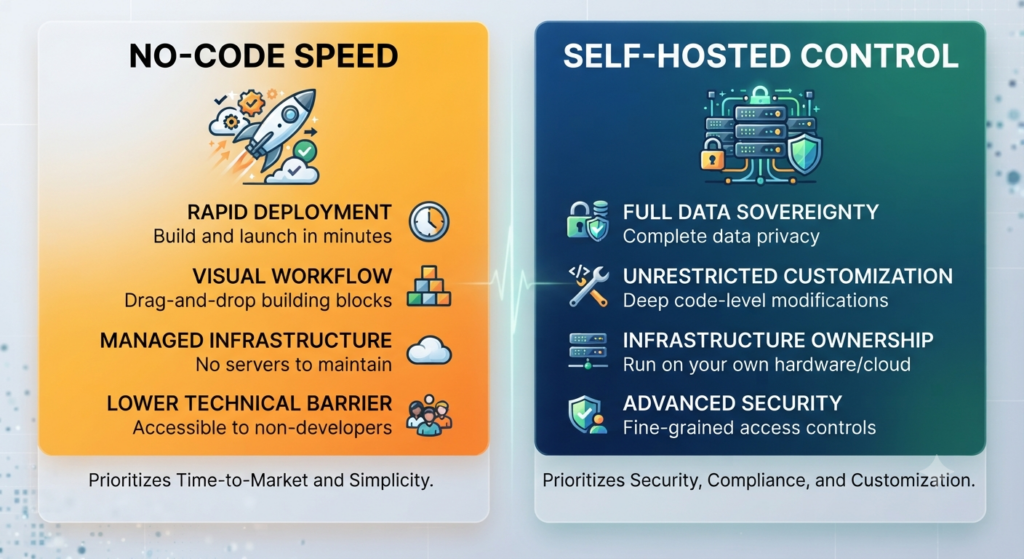
This is the choice that actually separates these platforms once billing is accounted for. No-code platforms (Zapier, Make, Gumloop, Lindy) get a team running in minutes with no infrastructure to manage, at the cost of per-task or per-operation fees that scale with usage. Self-hosted n8n eliminates that recurring cost structure entirely and gives full control over model choice, data residency, and agent architecture — genuinely valuable for teams with data sovereignty requirements or very high automation volume — but demands real engineering time to set up and keep running. Neither approach is objectively better; the right one depends on whether your team has, or wants, that engineering overhead.
How to Choose
- How technical is your team? Zapier or Gumloop for non-technical teams; n8n for teams with developers who want full control over model choice and hosting.
- How complex is your workflow logic? Simple, linear automations favor Zapier; workflows with branching, iteration, or aggregation favor Make or n8n.
- What’s your automation volume? High-volume, multi-step AI workflows get expensive fast on per-task billing (Zapier) — Make’s per-operation model or n8n’s self-hosted option scale more affordably.
- Do you need data to stay on your own infrastructure? n8n’s self-hosted option is the only one of the major platforms offering true data sovereignty.
- Do you want a workflow builder or a persistent agent? Zapier, Make, and n8n are built around discrete trigger-action workflows; Lindy AI’s persona model fits ongoing, proactive agent behavior better.
FAQ
Which AI automation platform is cheapest at scale? n8n self-hosted eliminates per-task costs entirely beyond your own server expense, making it the most cost-effective option for high-volume or technically capable teams. Among managed platforms, Make’s per-operation billing generally goes further than Zapier’s per-task model for complex, multi-step workflows.
Do I need coding skills to use these platforms? Zapier, Make, Gumloop, and Lindy AI are all built for non-technical users with visual, point-and-click builders. n8n is the exception — its deepest AI agent capabilities (custom LangChain nodes, RAG pipelines) genuinely benefit from development experience, though its core workflow builder is still no-code.
What’s the difference between an automation platform and an “AI employee” platform? Automation platforms like Zapier, Make, and n8n build discrete, trigger-based workflows — when X happens, do Y. “AI employee” platforms like Lindy AI use a persona-based approach for more proactive, ongoing agent behavior across email, calendar, and outreach, closer to delegating a task than configuring a workflow.
Can these platforms actually run autonomous AI agents, or just connect apps with AI steps added? It varies significantly by platform. n8n’s native LangChain integration and Zapier’s dedicated Agents product both support genuine autonomous, multi-step agent behavior; Make’s agent builder remains in beta. Evaluate this specifically rather than assuming “AI-powered” marketing language means full agentic capability.
Conclusion
The best AI automation platforms in 2026 aren’t separated primarily by which one has AI features — nearly all of them do now. The real differentiators are billing model, technical depth required, and whether you want a discrete workflow builder or a more persistent, proactive agent. Zapier wins on app breadth and ease of use, Make on complex logic per dollar, n8n on technical control and cost at scale, and Lindy AI on a genuinely different “AI employee” approach worth considering if a workflow builder isn’t really what you need.
Related Vynula Guides
- AI Employees Explained (2026)
- Best AI CRM Tools in 2026
- Best AI Customer Support Tools in 2026
- AI Agents Explained (2026)
- What Is AI Workflow Automation? (2026)
Official Source Package
- Zapier — https://zapier.com/
- n8n — https://n8n.io/
- Make — https://www.make.com/